





SEMICON India 2026 opened this week with a bigger mission budget, a fresh wave of startup funding, and the first signs that Indian companies are moving beyond assembly into actual chip design
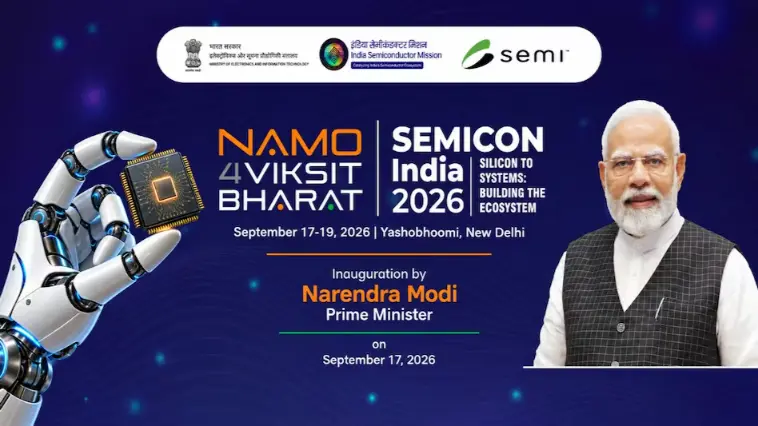
New Delhi’s Yashobhoomi convention centre spent three days this week hosting one of the more consequential gatherings in India’s technology calendar, as Prime Minister Narendra Modi inaugurated the fifth edition of SEMICON India on Thursday and used the occasion to announce a considerably larger second act for the country’s semiconductor programme.
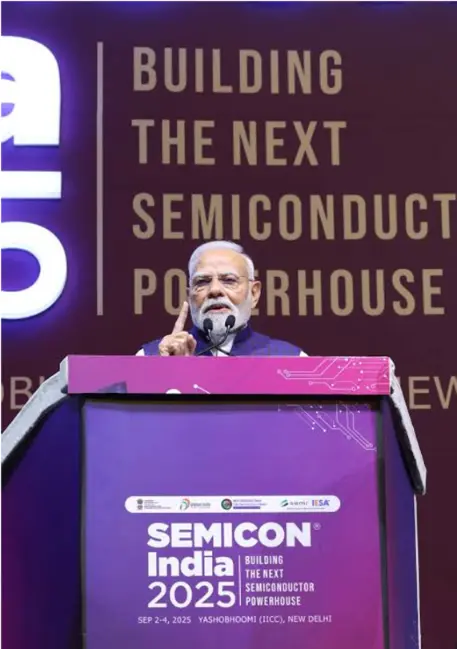
Prime Minister Narendra Modi inaugurates SEMICON India 2026 at Yashobhoomi in New Delhi
A Bigger Number for the Next Phase
Addressing an audience of industry leaders, researchers and policymakers from dozens of countries, Modi unveiled a 13.5 billion dollar second phase of the Semiconductor Mission, paired with regulatory changes intended to make it easier for international firms, startups and chip design companies to collaborate within India. The Prime Minister framed India’s growing economic stability and expanding talent base as reasons global semiconductor players should view the country as a dependable long-term partner, reiterating a now-familiar refrain about India’s reliability as a manufacturing destination even amid broader global economic uncertainty.
He also flagged power supply as a quietly critical piece of the puzzle going forward, noting that consistent, high-capacity electricity access would increasingly determine which countries could realistically support the kind of high-performance computing and advanced manufacturing that modern chip production demands.
The Scorecard So Far
The announcement arrived against a backdrop of measurable, if still early-stage, progress. Under the first phase of the mission, twelve semiconductor projects have been approved across six Indian states, carrying proposed investments exceeding 1.64 lakh crore rupees. Three of those facilities have already moved into commercial production, a detail Modi’s government has been keen to highlight as proof that years of policy groundwork are finally translating into functioning factories rather than remaining announcements on paper.
This year’s event itself reflected how much the gathering has grown alongside the ambitions it showcases. More than 600 companies from 52 countries took part, including global names like ASML, Applied Materials, Micron, NXP and Tokyo Electron alongside domestic players such as Tata Electronics and CG Power, spread across a three-day programme built around the theme of building a complete value chain from raw silicon to finished systems.
Startup Money Follows the Policy Money
Government investment was not the only capital in motion this week. The India Deep Tech Alliance, a coalition of private investors formed to channel funding into strategic technology sectors, disclosed that its members have deployed close to 2,170 crore rupees across 56 companies working in artificial intelligence and frontier technology during the alliance’s first year of operation. The breakdown offers a useful snapshot of where private capital sees the most promising opportunities within India’s deep tech landscape, with AI and AI-driven applications drawing roughly 639 crore rupees across 16 companies, quantum computing, robotics and space technology together pulling in about 649 crore rupees across 21 companies, and energy security and climate-transition ventures accounting for a further 655 crore rupees.
Alongside the funding update, the alliance also announced a partnership with industry body SEMI to establish an India Semiconductor Academy, aimed at converting the country’s large pool of engineering graduates into talent that chip companies can actually deploy on day one, a recognition that fabrication subsidies alone will not solve the ecosystem’s deeper skills gap.
A Sign Design Is Catching Up to Manufacturing
One of the more telling developments to emerge from the sidelines of the conference came from L&T Semiconductor Technologies, which used the event to unveil a portfolio of 40 chip products, a move that signals Indian companies are beginning to compete on chip design rather than confining themselves to assembly and packaging work further down the value chain. For an industry where India has historically played catch-up on the design side even while building out physical manufacturing capacity, a homegrown portfolio of this scale represents a meaningful, if early, shift in the country’s positioning within the global semiconductor supply chain.
Reading the Week as a Whole
Taken together, the week’s announcements point to a semiconductor push that is trying to mature on multiple fronts simultaneously rather than leaning solely on factory construction. Government capital is scaling up through the mission’s second phase, private investors are spreading bets across a wider range of frontier technologies beyond chips alone, and at least one Indian company is signalling ambitions in chip design that go beyond simply hosting other countries’ manufacturing. Whether that broader ecosystem can develop as quickly as the fabrication side has over the past four years remains an open question, but for an industry that spent years being measured mainly by how many factories it could announce, this week’s conversations suggest the metrics that matter are starting to widen.