






The Trinamool Congress turns to the Supreme Court after months of waiting for the Lok Sabha Speaker to act on defections that followed the party’s West Bengal defeat
A quiet but consequential legal battle is unfolding in Delhi over the fate of twenty Lok Sabha MPs who broke away from the Trinamool Congress earlier this year. With TMC leader Abhishek Banerjee now pushing the Supreme Court to force a decision on their disqualification, the case has become a fresh test of how India’s anti-defection law functions when a Speaker’s office moves at its own pace.
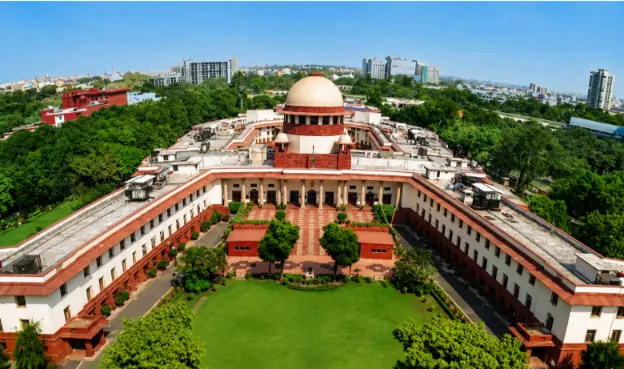
Supreme Court of India building in New Delhi, where the TMC MPs disqualification case was heard
A Rebellion Born Out of Defeat
The roots of this dispute trace back to the aftermath of the West Bengal Assembly elections, a contest that delivered a historic setback for the TMC and its long-serving leadership under Mamata Banerjee. In the weeks that followed, cracks within the party’s parliamentary wing widened into an open split, and by June, twenty of its Lok Sabha MPs had allegedly aligned themselves with a little-known outfit called the Nationalist Citizens Party of India, according to the TMC’s own account of events.
For a party still absorbing the shock of its state-level defeat, watching a fifth of its Lok Sabha strength walk away within months was a second blow the leadership was unwilling to absorb quietly.
Turning to the Rulebook
The TMC’s response was to invoke the Tenth Schedule of the Constitution, India’s anti-defection framework, filing disqualification petitions against the twenty MPs before Lok Sabha Speaker Om Birla. Abhishek Banerjee argued that the lawmakers, having been elected on the party’s symbol, could not simply switch allegiance without facing the consequences the Constitution lays out for exactly this situation.
Months passed without a ruling, and the party grew impatient. Banerjee eventually moved the Supreme Court himself, filing a petition that named not the rebel MPs but the Speaker’s office and the Lok Sabha Secretary General as respondents, arguing that the delay itself had become the problem.
The Court Draws a Careful Line
When the matter came up before a bench led by Chief Justice of India Surya Kant, alongside Justices Joymalya Bagchi and V Mohana, the judges were notably cautious about how far to push a constitutional authority like the Speaker. Solicitor General Tushar Mehta, representing Birla’s office, informed the court that notices had already gone out to all twenty MPs on the disqualification petitions, prompting the bench to hold off on issuing formal notice to the Speaker himself.
Justice Bagchi was careful to frame the court’s concern narrowly, noting that the issue was not whether notices had been sent but whether the proceedings could be brought to a timely conclusion. The court ultimately issued notice to the twenty MPs directly and sought their responses, while leaving the question of timeline squarely on the Speaker’s desk for now.
That position hardened somewhat a day later, when the Lok Sabha Secretariat, acting on the Speaker’s instructions, sent formal notices to all twenty lawmakers dated August 25, giving them seven days to respond to Banerjee’s original petition.
A Split That Runs Deeper Than Delhi
TMC MP Kalyan Banerjee offered a telling detail about the party’s broader strategy while speaking to reporters after the hearing. He indicated that the party had chosen to pursue action against its Parliament members first, with plans to turn its attention to defecting MLAs at the state level next, suggesting the twenty Lok Sabha MPs may be only the first chapter of a larger internal reckoning within the party.
In the meantime, the rebel MPs have not been treated as ordinary opposition lawmakers within the House itself. The Speaker’s office allotted them separate seating arrangements during the Monsoon Session, an administrative signal that their status remains genuinely contested even as formal disqualification proceedings crawl forward.
A Familiar Pattern in Indian Politics
Disputes over delayed disqualification decisions are hardly new to Indian legislatures. Similar standoffs have played out in state assemblies from Karnataka to Himachal Pradesh over the years, often turning on the same tension at the heart of this case, an anti-defection law that sets out clear grounds for disqualification but leaves the timeline for deciding such cases largely to the discretion of the presiding officer. Courts have periodically stepped in to nudge that process along without directly overriding a
Speaker’s constitutional authority, and the current case appears to be following much the same script.
Where This Leaves Both Sides
With responses due from the rebel MPs and the Speaker’s office now formally engaged, the case is likely to keep both the TMC and its former lawmakers in a state of legal limbo for at least the coming weeks. For Abhishek Banerjee, a favourable and swift outcome would send a clear signal to any other MPs weighing similar moves ahead of future state elections. For the rebel MPs, the coming responses will determine whether their political future rests with the party symbol they were elected on or the new political home they chose to join.