


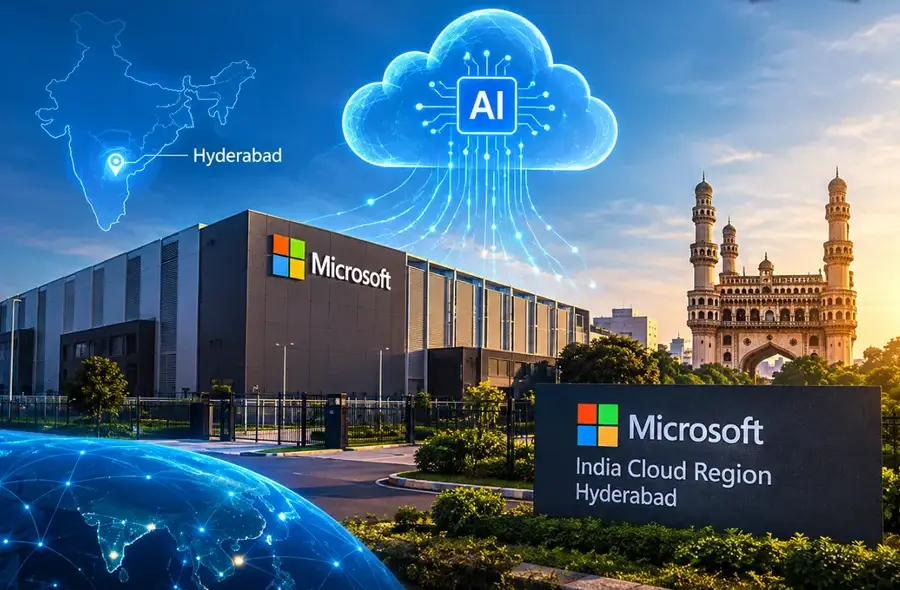


The Hyderabad facility, part of a $20.5 billion investment pledge, arrives built for AI workloads and designed to sidestep the power and water constraints that have slowed other data centre projects.
Microsoft used its AI Infrastructure Summit in New Delhi on Monday to flip the switch on its fourth cloud region in India, a Hyderabad facility called India South Central that the company is positioning not just as another data centre but as a strategic hub serving both Asia and the wider Global South.
Server racks inside a modern data centre representing Microsoft’s new India South Central cloud region
Hyderabad Joins a Three-City Map
The new region expands Microsoft’s Indian cloud footprint beyond its existing facilities in Pune, Chennai and Mumbai, and arrives as the most tangible piece yet of the company’s broader 20.5 billion dollar investment commitment to the country, a figure that combines 17.5 billion dollars pledged for the 2026 to 2029 period on top of 3 billion dollars already invested previously. Puneet Chandok, President of Microsoft India and South Asia, described the launch as the moment that overall commitment starts turning into operational infrastructure that Indian enterprises can actually run their businesses on.
Built to Run Where Water and Power Are Scarce
What sets this facility apart on paper is less its size than its engineering choices. The region is structured around a three-zone architecture, with each zone maintaining independent power, cooling and networking, and data replication running across zones to support backup and recovery with latency kept under two milliseconds. Microsoft has also built the facility around zero-water cooling technology, a deliberate design decision given how frequently data centre expansion in India runs into exactly the kind of power availability and water scarcity constraints that have slowed similar projects elsewhere in the country.
The Data Gap Driving the Investment
Chandok framed the investment against a statistic that has increasingly shaped how global cloud providers think about India, noting that the country generates around 20 percent of the world’s data while currently hosting only about 3 percent of global data centre capacity. That mismatch sits at the heart of Microsoft’s expansion logic, and the company’s own projections suggest India’s total data centre capacity could grow from roughly 2 gigawatts today to somewhere between 12 and 14 gigawatts by 2035, a scale of build-out that would require sustained investment from Microsoft and its competitors alike over the coming decade.
Enterprise India Signs On Early
The new region has not launched without customers already lined up. Organisations including Adani Group, Bajaj Finserv, HDFC Bank and PB Pay have signed on to run workloads through India South Central, spanning sectors from financial services to conglomerate-level infrastructure. For regulated industries in particular, the region’s design also extends Microsoft’s sovereign public cloud capabilities in India, offering local data residency options intended to help organisations meet requirements under the country’s Digital Personal Data Protection framework and other sector-specific compliance expectations.
Skilling Comes Attached to the Steel and Silicon
Microsoft has been careful to frame this expansion as more than a physical infrastructure story. Alongside the data centre build-out, the company has reiterated its target of training 20 million people in India by 2030, tying its cloud investment to a parallel commitment around workforce development. That pairing reflects a broader argument the company has been making about India’s AI ambitions, that local compute capacity alone does not translate into economic impact unless enough people are equipped to actually build on top of it.
The Road to 14 Gigawatts
With India South Central now live and additional Azure and AI services expected to roll out over the coming months, the immediate story is one of infrastructure catching up to demand rather than a finished product. Microsoft already employs more than 22,000 people across Indian cities including Bengaluru, Hyderabad, Pune, Gurugram and Noida, some of them working on AI products with global reach rather than purely domestic deployments. Whether the company’s broader 20.5 billion dollar commitment keeps pace with the aggressive capacity targets it has set for itself will depend heavily on how quickly power grids, water access and regulatory approvals can be lined up to support a build-out of this scale, a challenge every hyperscaler betting big on India is currently working through in parallel.