




Bitchat, built to work without internet or servers, gets pulled from both app stores after a government order invokes a two-decade-old blocking law
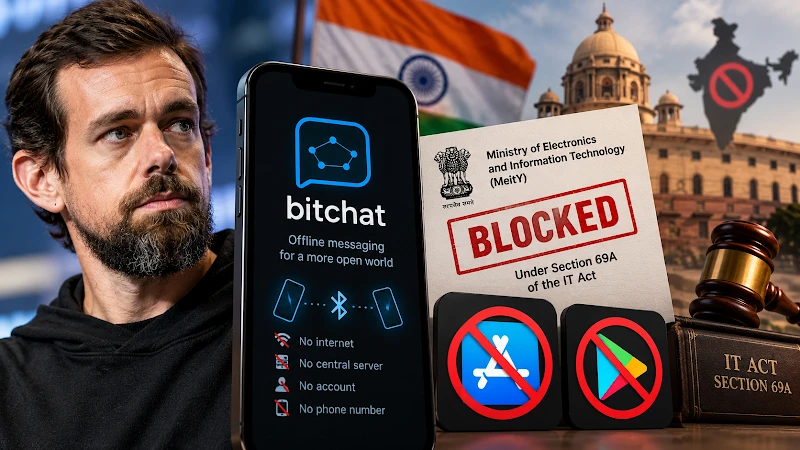
A messaging app designed specifically to function when the internet doesn’t has run into a wall the internet itself cannot help it around. Bitchat, the peer-to-peer encrypted messaging platform created by Twitter co-founder Jack Dorsey, has been removed from both the Apple App Store and Google Play Store in India, following a government takedown order that Dorsey himself disclosed on social media over the weekend.
An App Built to Route Around the Network, Not the Law
Bitchat occupies an unusual niche in the messaging app landscape. Rather than routing messages through central servers the way most chat apps do, it uses Bluetooth Low Energy mesh networking to let nearby devices communicate directly with each other, requiring no internet connection, no cellular service and no user accounts. Conceived by Doris Lima and developed by Dorsey through his company Block, the app was first announced in July last year and has been pitched as a resilient communication tool for situations where conventional networks are unavailable, congested or deliberately shut down. That exact design feature appears to be precisely what has drawn regulatory attention in India.
The Notice That Broke the News
Dorsey shared a screenshot on X of an email he said came from Apple’s App Review team, captioning it with the blunt observation that the Indian government had officially pulled Bitchat from the App Store. According to the notice, Apple stated the app would be removed from India’s storefront following a demand from the Ministry of Electronics and Information Technology, citing content the ministry considered illegal under Indian law. The notification did not specify which particular content triggered the action, and Apple advised the developer to approach the ministry directly for further detail. Beyond the storefront listing itself, Apple indicated that TestFlight beta access would also be disabled for Indian users, with public testing links ceasing to function within the country.
The Legal Lever Behind the Order
The takedown was issued under Section 69A of India’s Information Technology Act, 2000, a provision that gives the central government direct authority to block public access to online content on grounds including the sovereignty and security of the state and the maintenance of public order. Orders issued under this section follow procedures laid out in the government’s 2009 Blocking Rules, a framework that has previously been used against a range of applications and websites, including an April 2023 request from India’s Cyber Crime Coordination Centre to block fourteen applications in Jammu and Kashmir over alleged use by terrorist groups and their sympathisers.
Not the First Time This App Has Drawn Scrutiny
This is not India’s first move against Bitchat specifically. Back in July, the government had already directed GitHub to remove multiple code repositories linked to the app, with officials citing concerns that its decentralised, serverless design could be exploited to evade lawful surveillance and facilitate unlawful activity, concerns that echo almost precisely the rationale now being applied to this latest storefront removal.
A Possible Trigger Closer to Home
Some reporting has tied the timing of this latest order to a more specific episode, suggesting the app had come to the government’s attention after reportedly being used during protests linked to the Citizens for Justice and Peace organisation at Delhi’s Jantar Mantar, a demonstration during which temporary internet restrictions were imposed in the surrounding area. An app capable of letting nearby devices communicate without any internet connection at all would, almost by design, be able to function straight through exactly that kind of localised shutdown, a capability that may explain why authorities moved against it so directly. Congress leader Priyank Kharge was among those who publicly noted the development, flagging the removal of Bitchat access in India following what he described as a demand from the central government.
Pushback From Digital Rights Groups
The move has not gone unchallenged. The Internet Freedom Foundation, a digital rights organisation that had already criticised the earlier GitHub takedown order as unconstitutional and authoritarian, has continued to voice concern over how Section 69A is being applied to decentralised communication tools. For Dorsey’s part, he had claimed following the July action that the Indian government simply did not like technologies like Bitchat and wanted them removed, a characterisation the government has not directly addressed in its own public statements on the matter.
India Joins a Short but Notable List
India is not the first country to take this kind of action against Bitchat. Apple had previously removed the app from its store in China back in April, following a request from authorities there, making India only the second country where the Cupertino-based company has pulled Bitchat at a government’s request. The parallel is a telling one, placing India alongside a government not typically associated with it in public discourse on digital rights, united in this instance by a shared discomfort with technology explicitly designed to resist centralised control and surveillance.
What This Means for Decentralised Tech in India
The Bitchat removal lands at a moment when questions about how far governments can and should reach into decentralised, peer-to-peer technology are becoming increasingly live, not just in India but globally. With draft amendments to India’s IT rules already proposing stricter and faster content removal timelines for platforms more broadly, this episode may prove to be an early test case for how regulators intend to treat a growing category of apps built specifically to operate outside the kind of centralised infrastructure that takedown orders have traditionally targeted.