




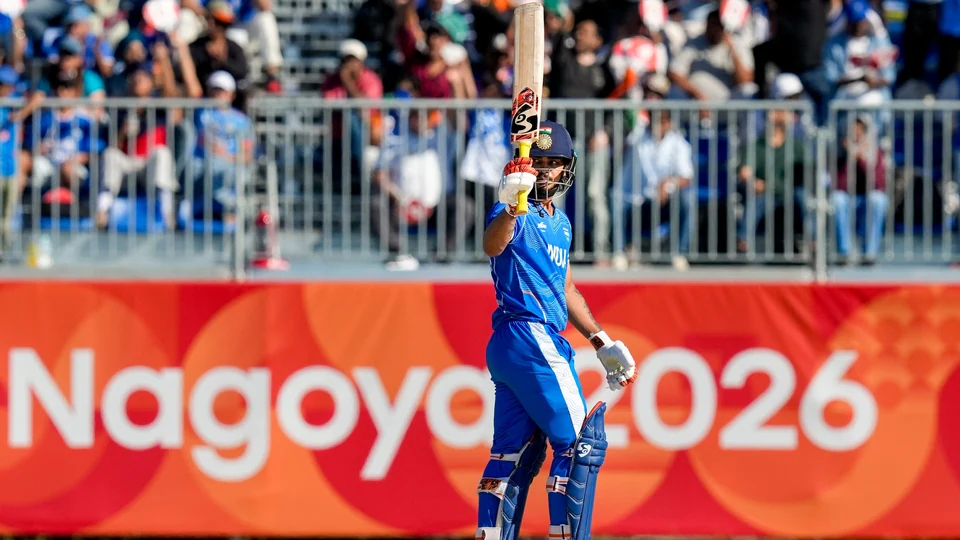
With hockey and boxing titles already banked, Ishan Kishan’s personal milestone headlines a mammoth total as India chase a second straight cricket gold against Pakistan
Saturday turned into one of the most productive single days of India’s entire Asian Games campaign in Aichi-Nagoya, with gold medals arriving in women’s hockey and boxing well before the headline event of the day, the men’s cricket final against Pakistan, had even finished its first innings.
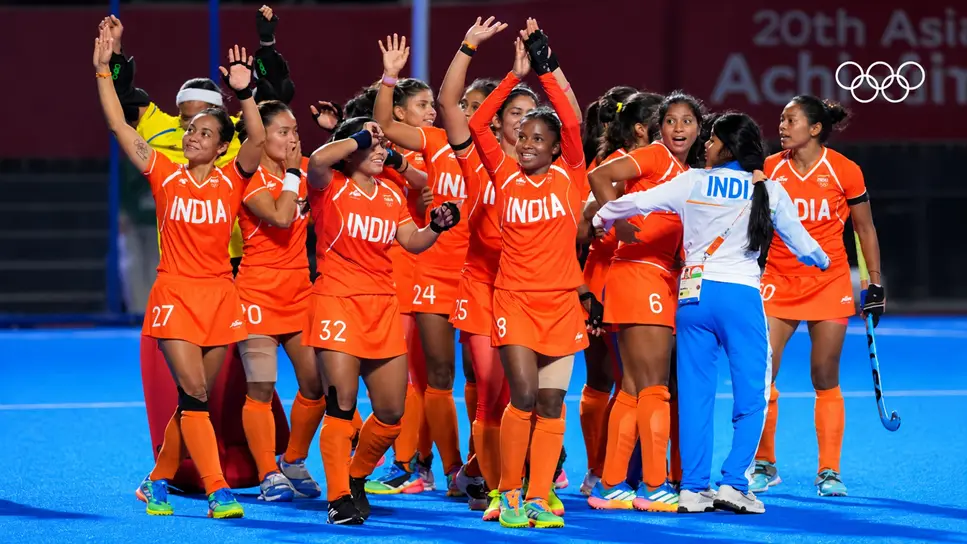
India’s women’s hockey team celebrates winning gold at the Asian Games 2026 after defeating China
A Morning Already Worth Celebrating
Long before a ball was bowled in the cricket final, India’s contingent had reason to celebrate. The women’s hockey team edged China 1-0 in their gold medal match, a result that did double duty by also securing India direct qualification for the 2028 Los Angeles Olympics, sparing the team the uncertainty of a qualifying tournament down the line. In the ring, Indian boxers added further gold to the tally, taking their count to three boxing titles at this single edition of the Games, a tally that speaks to the growing depth of India’s boxing programme beyond its usual headline names.
With the men’s hockey team also scheduled to face Malaysia for gold later in the day, carrying its own Olympic qualification stakes, Saturday had shaped up as a day capable of defining how India’s entire Games campaign is remembered.
Kishan Writes His Name Into the Record Books
Against that backdrop, the men’s cricket final at Korogi Sports Park added its own slice of individual history. Wicketkeeper-batter Ishan Kishan became only the second Indian batter ever to cross 1,000 T20I runs in a single calendar year, reaching the landmark during his innings against Pakistan in the gold medal match. For a format increasingly crowded with record-breaking tallies, becoming just the second name on that particular list places Kishan’s 2026 season in genuinely rare company.
A Total Built on Waves, Not a Single Flood
India’s innings after winning the toss and batting first followed a pattern of short, violent bursts rather than one sustained partnership. Vaibhav Sooryavanshi set an aggressive tone early, striking two sixes in a rapid 15 off just nine balls before departing, and Abhishek Sharma picked up the baton from there, continuing his extraordinary year with a 28-ball fifty built on three fours and seven sixes en route to 61.
Kishan and captain Shreyas Iyer then shouldered the responsibility of consolidation, adding 20 and 21 respectively to steady the innings through its middle overs and set up a platform for the finishing acceleration that followed. That platform was put to spectacular use by Tilak Varma, who blazed to an unbeaten 51 off just 22 balls, and Shivam Dube, who provided the final flourish with 27 not out from 15 deliveries, the pair combining to power India to a formidable 211 for 6 at the end of their twenty overs.
Defending More Than Just a Target
India enter this final as the defending champions in the discipline, adding an extra layer of significance to the result regardless of how Pakistan’s chase unfolds. A total in excess of 200 on an Asian Games pitch represents a serious examination for any chasing side, and with the bowling attack that has carried India through the knockout rounds now tasked with defending it, the gold medal match looked, at the innings break, to be firmly tilted in India’s favour.
A Day That Could Define the Campaign’s Legacy
Whatever the final cricket scoreline, Saturday’s combination of a hockey gold with built-in Olympic qualification, a fresh wave of boxing titles, and a batting masterclass in the cricket final gives India’s Asian Games campaign a defining closing chapter. With the men’s hockey team still to play for gold against Malaysia later in the day, India’s contingent has a genuine chance to turn October 3 into one of the most decorated single days in the country’s recent Asian Games history, a fitting final push as the
Aichi-Nagoya Games draw toward their closing ceremony.