





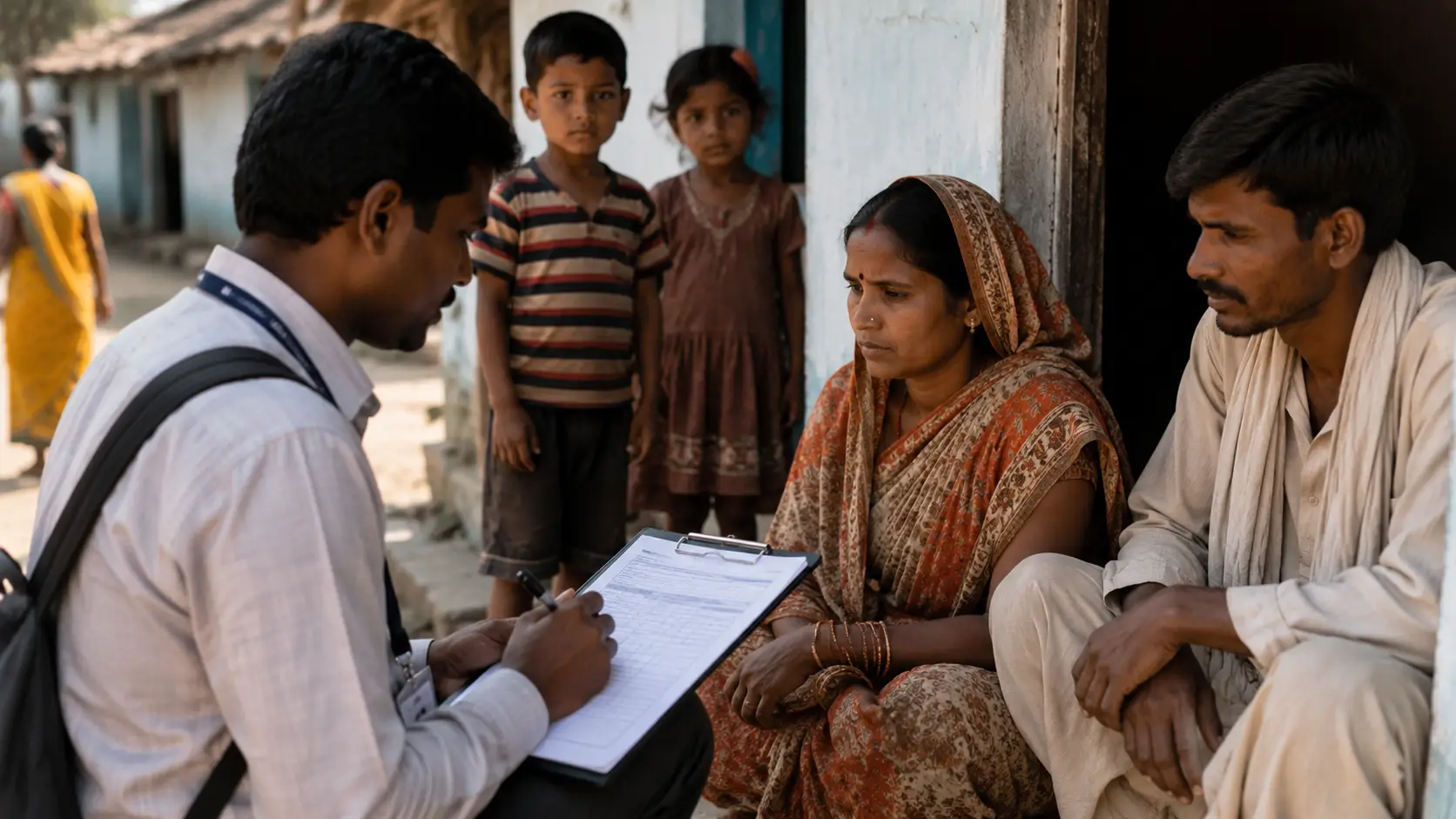
What is Census?
A census is a systematic collection and analysis of data about the entire population of a country or region. It doesn’t just count the number of people, it also collects information such as age, gender, education, employment and other characteristics. This data is essential for the government to plan resource allocation, design public policies and welfare programs, plan infrastructure such as schools, hospitals, housing, and understand population changes.
How will Census 2027 be conducted?
Census 2027 will be conducted in 2 phases:
Phase I: House Listing and Housing Census (HLO) scheduled between April and September 2026 collects information about houses, housing conditions, household amenities and assets. Each State and Union Territory will conduct it over a period of 30 days to create a basic framework or housing list required for the second phase of the Census. Before the house-to-house HLO operation, there is an optional 15-day self-enumeration period where people can submit their household information through a secure online portal.
Phase II: Population Enumeration (PE) is scheduled for February 2027, and the focus will be on capturing detailed demographic, socio-economic, cultural, migration, and fertility related information of individuals across households. The caste enumeration will also be conducted during this phase. There is an exception for certain areas. For the Union Territory of Ladakh and areas of Jammu and Kashmir, Uttarakhand and Himachal Pradesh, Phase II will be conducted earlier, in September 2026.
Why was broader caste data not included in the 2011 Census?
The Socio-Economic and Caste Census (SECC) 2011 was conducted separately from the regular Census and collected information on caste as well as the socio-economic conditions of households. According to Wikipedia, the exercise recorded 4,673,034 caste-related entries, including caste and sub-caste names, synonyms, different surnames, gotras and clan names.
The large number of variations made it difficult to compile and standardise the caste information. According to the figures reported by Wikipedia, 81,958,314 errors were identified in caste particulars, of which 67,381,119 were corrected, while 14,577,195 remained uncorrected at the time of the government’s 2015 update.
The SECC data was later criticised by some experts as unreliable. These issues highlighted the difficulty of collecting and consistently classifying India’s diverse caste identities.
What’s new in census 2027?
According to the Press Information Bureau (PIB), the 2027 census will be India’s first digital census where enumerators will use mobile-based systems to collect information. The government has notified 40 questions for the Population Enumeration phase, compared with 29 questions in the 2011 Census. The new system includes:
Census Management & Monitoring System (CMMS) – This will manage and monitor the census by allowing officials at sub-district level, district level, state and national level to track things like enumeration progress, field performance and operational readiness.
Houselisting Block Creator (HLBC) – This is a web-based mapping application that will use satellite imagery to digitally create houselisting blocks. The goal is to ensure that the geographical areas are properly covered and prevent areas from being missed or counted more than once.
Self-enumeration – The portal: https://se.census.gov.in/ will be used by households before the house-to-house visit and receive their Self-Enumeration ID (SE ID). Then the enumerator uses that ID to confirm the information during the field visit.
Comprehensive caste enumeration – The inclusion of caste enumeration in the Census is one major change. The 2011 Census enumerated SCs and STs, Census 2027 will include caste enumeration for all communities.
Stronger data security – The digital system will use end to end encryption, secure data centres and regular security audits to protect the collected information.
Why does caste data matter?
One of the main reasons for conducting caste enumeration is to examine the socio-economic conditions of different caste groups. This can help create policies based on their current conditions. For this reason, caste data is vital. Caste data can be used to determine the position and representation of all the caste groups. This can help policymakers design welfare schemes, policies, and affirmative action accordingly. Moreover, taking a census of caste is a politically charged issue. Previous attempts to collect caste data also faced difficulties. The sample Household Survey conducted between 2011 and 2013 recorded thousands of castes and sub-caste names, raising concerns about inconsistencies in the data. This highlights the need for accurate and comprehensive caste data. The Census aims to provide a broader picture of India’s caste composition.
What are the challenges?
The obvious hurdle would be rolling out secure tech infrastructure for 34 lakh enumerators, managing public cooperation and handling massive amounts of data collected. The digital nature of the Census will create cybersecurity risks across the entire data lifecycle, from collection and transmission to storage and publication.
Another issue could be that the open-ended caste question could again result in different spellings, surnames, local names and sub caste descriptions for the same community, as happened in the 2011 SECC which generated many caste names.
There are also concerns around privacy and public trust, particularly because the Census will collect sensitive personal information digitally. Although the government has proposed encryption, secure data centres and security audits, ensuring that such a large system remains secure will be a major challenge.
Conclusion
The government has introduced safety measures such as end-to-end encryption, multi-factor authentication, Aadhaar based verification for self-enumeration and hosting on certified data centres. The reliability of the final dataset will also depend on people providing accurate information, since inaccurate or incomplete responses might affect its overall quality.