





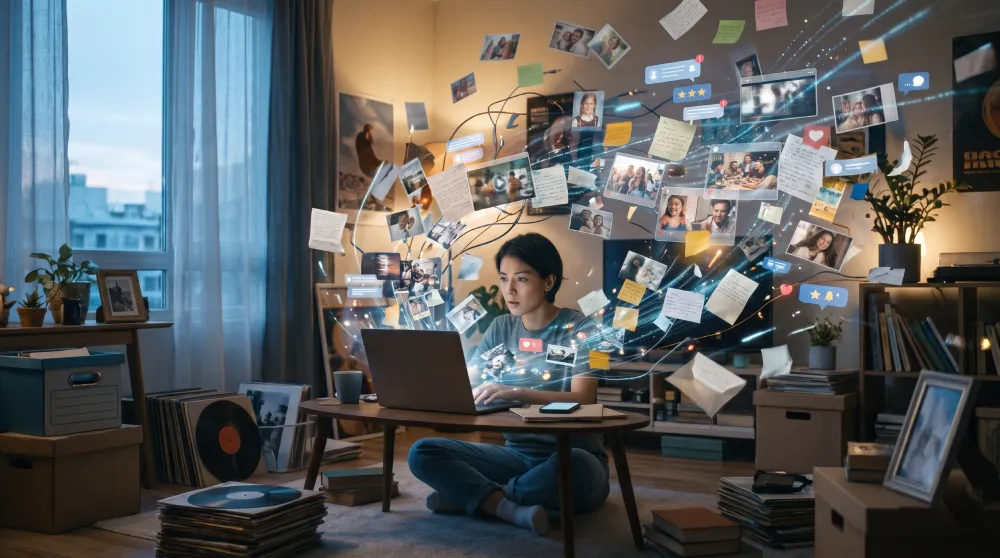
There are days when the past returns without anyone inviting it. You might be scrolling through Instagram when an old photograph appears, reminding you of a school friend you have not spoken to in years. You might hear a song that suddenly takes you back to a particular evening, or find an old message buried in a conversation you thought you had forgotten. For a moment, the distance between then and now seems to disappear.
Earlier, memories usually depended on photographs stored in albums, letters tucked inside drawers, or stories shared during family gatherings. Today, the internet has created a different kind of relationship with memory. It does not simply allow us to remember the past; it keeps bringing the past back into our present lives, sometimes when we least expect it.
The Past Is Never Completely Gone
One reason the internet keeps reviving old memories is that very little disappears completely. Photographs remain on cloud storage, old posts stay on social media profiles, and conversations continue to exist long after the people involved have stopped talking. Even when we move on emotionally, our digital lives may preserve moments we no longer think about.
A memory that once depended on our ability to recall it can now return through a notification. Social media platforms remind us of posts shared years ago, while photo applications collect pictures from different periods of our lives. These features are designed to help us revisit meaningful moments, but they can also bring back experiences we believed belonged to another chapter.
The strange thing is that digital memories do not age in the same way as physical objects. A photograph in an old album might remain untouched for decades. An online photograph, however, can suddenly appear between a news update and a friend’s vacation picture. The past becomes part of an ordinary afternoon.
When Algorithms Become Unexpected Storytellers
The internet does not remember everything in the way humans do. It stores information, identifies patterns and uses algorithms to decide what might interest us. Based on our previous activity, platforms may recommend old videos, familiar songs, forgotten posts or content connected to people we once followed.
This creates an unusual experience. Sometimes, we revisit the past because we choose to. At other times, technology makes that choice for us.
An old photograph might remind someone of a friendship that ended peacefully, while the same kind of reminder might bring back an uncomfortable memory for another person. The algorithm cannot fully understand the emotional meaning behind a photograph. It can recognize a date, a face or a pattern of engagement, but it cannot know whether the memory is comforting or painful.
In this way, technology becomes an unexpected storyteller. It brings back fragments of our lives without always understanding the stories attached to them.
Nostalgia Has Become Part of Internet Culture
Nostalgia is no longer limited to personal memories. It has become a shared part of online culture. Old television shows, childhood cartoons, vintage fashion, early internet trends and songs from previous decades regularly return through reels, memes and short videos.
People who grew up in different places can suddenly connect over the same childhood advertisement or a television programme they watched after school. A familiar tune can fill a comment section with stories about school days, family traditions and simpler routines.
These online moments show that remembering is not always a lonely activity. Sometimes, the internet helps people discover that others remember the same things.
However, online nostalgia can also create an edited version of the past. A short video may show only the happiest moments of a particular decade, leaving out its difficulties. When thousands of people celebrate an idealized childhood or an earlier era, the past can begin to appear more perfect than it actually was.
We may not be missing the entire past. We may simply be missing the parts that looked beautiful when viewed from a distance.
Old Memories Can Complicate New Beginnings
The return of the past is not always harmless. An old message from someone we once trusted can raise questions we thought we had answered. A photograph from a former friendship can make us wonder when things changed. Even seeing an old version of ourselves can create mixed feelings.
There is a particular kind of discomfort in looking at a digital memory and realizing how different life has become. The people in the picture may have moved away, changed their priorities or disappeared from our lives entirely. Yet the photograph preserves the moment as if nothing could ever change.
This can make moving forward complicated. We are trying to build new experiences while constantly carrying reminders of old ones in our pockets.
Still, remembering the past does not necessarily mean being trapped in it. Sometimes, an old photograph helps us understand how much we have learned. Sometimes, a forgotten conversation reminds us of a mistake we would not make today. Memories can offer perspective when we allow ourselves to see them honestly.
Learning to Live With a Digital Past
Perhaps the real challenge is not to stop the internet from bringing back memories, but to decide what we want to do with them.
We can revisit an old photograph without wishing to return to that time. We can appreciate a former friendship without trying to recreate it. We can acknowledge that a particular period mattered to us while accepting that it has ended.
We can also take control of our digital spaces. Archiving photographs, adjusting memory notifications and choosing what remains visible can help us create a healthier relationship with our online history. Not every moment needs to be preserved in public, and not every memory deserves our attention whenever an algorithm decides to display it.
The internet may keep our past within reach, but it does not have to decide how we feel about it.
Conclusion
The internet keeps bringing back the past because our digital lives rarely have a clear ending. Old photographs, forgotten conversations and familiar songs continue to exist alongside everything happening today. Technology makes these memories easier to find, but it also makes them harder to leave undisturbed.
Perhaps this is one of the most human contradictions of the digital age: we want to remember the moments that made us who we are, yet we also need room to become someone new.
The past will probably continue appearing on our screens, sometimes as a pleasant surprise and sometimes as an unexpected reminder. We cannot control every memory that returns, but we can choose whether to revisit it, learn from it or simply let it pass.
After all, our memories are a part of our story, not the whole story. The internet may keep turning the pages backward, but we are still the ones living what comes next.