





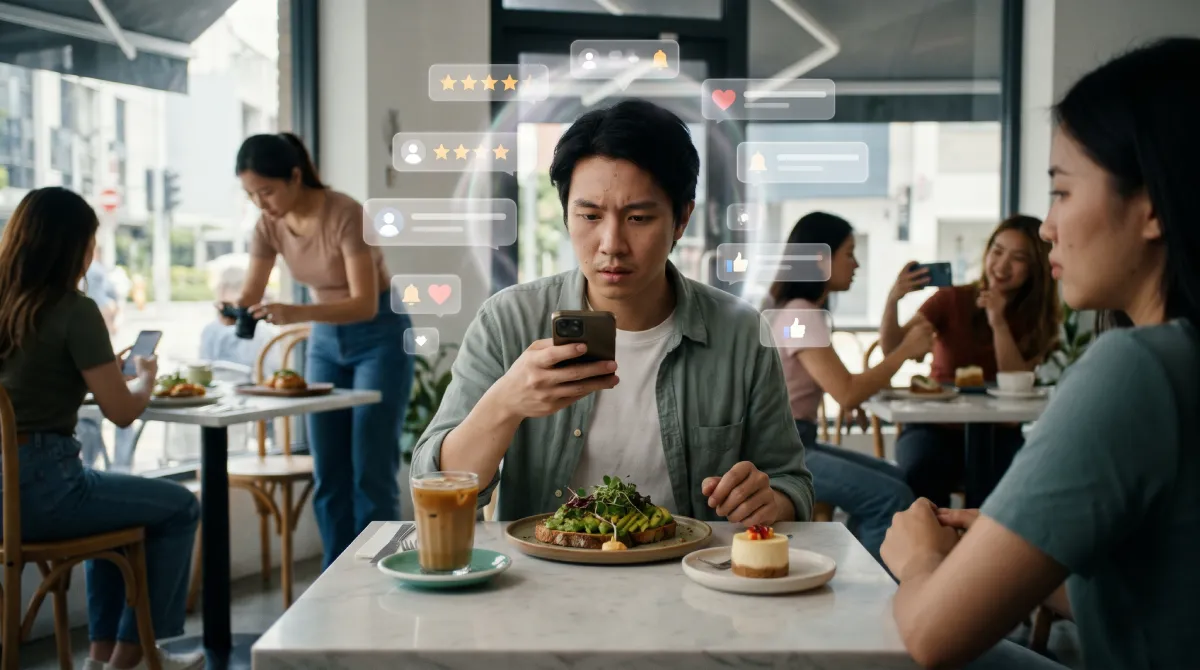
There was a time when people collected memories in photo albums, shared stories with friends over tea, and kept certain moments entirely to themselves. Today, a beautiful sunset, a birthday celebration, a late-night conversation, or even a cup of coffee can become content within seconds. With just a few taps, an ordinary moment can be turned into a photograph, a reel, or a story for hundreds of people to see. Somewhere between sharing our lives and documenting them, however, a new kind of pressure has quietly entered our daily routines: the pressure to have an interesting online life.
Social media was originally seen as a way to stay connected with people, especially those living far away. It allowed us to share experiences, express opinions, and discover different perspectives. But gradually, these platforms became more than spaces for communication. They became places where people present carefully selected versions of themselves. A holiday looks more exciting with the right photograph, a normal day seems incomplete without a story, and an achievement feels even more satisfying when others acknowledge it online.
The problem begins when sharing experiences turns into a need to prove that our lives are worth watching.
When Ordinary Life Starts Feeling Ordinary
Imagine spending an entire Sunday at home. You wake up late, eat your favourite food, watch a movie, and enjoy a peaceful afternoon. In reality, it might be exactly the kind of day you needed. Yet, after scrolling through social media, you see someone attending a concert, another person travelling to a beautiful destination, and someone else celebrating an achievement. Suddenly, your peaceful Sunday begins to feel unproductive or uninteresting.
Nothing about your day has changed. Only your perception of it has.
This is one of the strange effects of social media. We compare our everyday experiences with the most attractive moments other people choose to share. We rarely see the boredom, arguments, financial difficulties, or disappointments that exist behind those photographs. We see the finished picture, not the entire story.
As a result, people sometimes begin to believe that an exciting life means constantly doing something worth posting. Staying home becomes boring, a simple celebration feels insufficient, and an ordinary weekend appears to be a waste of time. Life starts being measured not only by how it feels but also by how it might look to someone else.
Living for the Camera
One of the clearest signs of this pressure is the way people sometimes experience moments through a camera before experiencing them personally.
At a birthday party, someone may spend several minutes finding the perfect angle instead of enjoying the celebration. During a trip, the first thought might be which location will look best in photographs. Even a meal can become a small production involving lighting, arrangements, and multiple attempts to capture the perfect image.
Of course, taking photographs is not wrong. Memories deserve to be preserved, and sharing beautiful experiences can bring happiness. The difficulty arises when the need to record everything begins to interfere with the experience itself.
A person may visit a wonderful place but spend so much time creating content that they barely notice their surroundings. They may laugh at a joke while secretly wondering whether the moment would make a good reel. Gradually, the experience becomes divided into two parts: the moment itself and the version of the moment prepared for an audience.
This raises an uncomfortable question: if we are constantly thinking about how our lives appear to others, how much attention are we giving to the lives we are actually living?
The Fear of Missing Out
Another important reason behind this pressure is the fear of missing out, commonly known as FOMO. Social media allows us to witness events happening in other people’s lives almost instantly. While this connectivity can be wonderful, it can also create the feeling that everyone else is experiencing something more exciting.
A friend posts pictures from a party, classmates share photographs from an event, and acquaintances upload updates about their achievements. Even when we had no plans to attend those events, seeing them online can make us feel excluded.
For some people, this feeling creates a constant desire to remain socially active. They may agree to plans they do not really enjoy, spend money on experiences they cannot comfortably afford, or feel uncomfortable when they have nothing interesting to share.
The pressure can be particularly strong among young people, who are still discovering their identities and trying to understand where they belong. When popularity appears to be measured through likes, comments, followers, and views, it becomes easy to confuse online attention with personal worth.
However, being visible is not the same as being valued. A person can have thousands of followers and still feel lonely, while someone with a small circle of friends can enjoy meaningful relationships and genuine happiness.
The Hidden Cost of Always Being Interesting
The expectation of maintaining an exciting online identity can become emotionally exhausting. People may feel that they need to look happy even when they are having a difficult week. They may avoid discussing ordinary struggles because such experiences do not fit the image they have created. Others may feel embarrassed about their achievements if those achievements receive little attention.
Over time, this can turn self-expression into self-monitoring. Instead of asking, “Am I enjoying this?”, people begin asking, “Will people find this interesting?”
There is also a financial side to the issue. The desire to appear successful or adventurous can encourage unnecessary spending on fashionable clothes, expensive outings, travel, and celebrations. People may feel pressured to maintain a lifestyle that looks impressive online, even when it does not match their financial circumstances.
What begins as a harmless desire to share happiness can gradually become a competition without a finish line. There will always be another person with a better photograph, a more exciting holiday, or a more popular post.
The exhausting part is that there is no final achievement that guarantees permanent satisfaction. Once one post receives attention, another may be expected to perform just as well.
Learning to Enjoy an Unposted Moment
The solution is not to reject social media completely. These platforms can inspire creativity, build friendships, support careers, and help people discover opportunities they might never have encountered otherwise. The real challenge is learning to use them without allowing them to determine the value of our experiences.
Sometimes, the healthiest choice is to enjoy a moment without documenting it. Attend a family gathering without worrying about photographs. Take a walk without searching for the perfect background. Spend time with friends without feeling that every conversation needs to become a story.
It also helps to remember that people have different definitions of an interesting life. For one person, it might mean travelling across countries. For another, it might mean learning a new skill, caring for family members, reading quietly, or simply finding peace after a difficult period.
None of these lives is automatically more meaningful than another.
We should also become more conscious of what we consume online. Following accounts that constantly make us feel inadequate can affect how we view ourselves. Taking occasional breaks, limiting unnecessary comparisons, and remembering that social media presents selected moments rather than complete lives can help restore perspective.
Most importantly, we need to give ourselves permission to be ordinary sometimes. Not every day needs a celebration, every weekend needs an adventure, or every achievement needs public recognition.
Conclusion
The pressure to have an interesting online life reflects a larger change in how we understand happiness, identity, and social approval. We have become accustomed to sharing our experiences so quickly that we sometimes forget that experiences have value even when nobody else knows about them.
A life does not become meaningful because it attracts attention. It becomes meaningful through the relationships we build, the lessons we learn, the kindness we show, and the small moments that make us feel genuinely alive.
Perhaps the most important thing we can learn in an age of constant sharing is that we do not have to turn every moment into content. Some memories can remain private, some days can be completely uneventful, and some experiences can belong only to us.
After all, the purpose of living is not to create a life that looks interesting to everyone else. It is to build a life that feels meaningful to the person living it.