




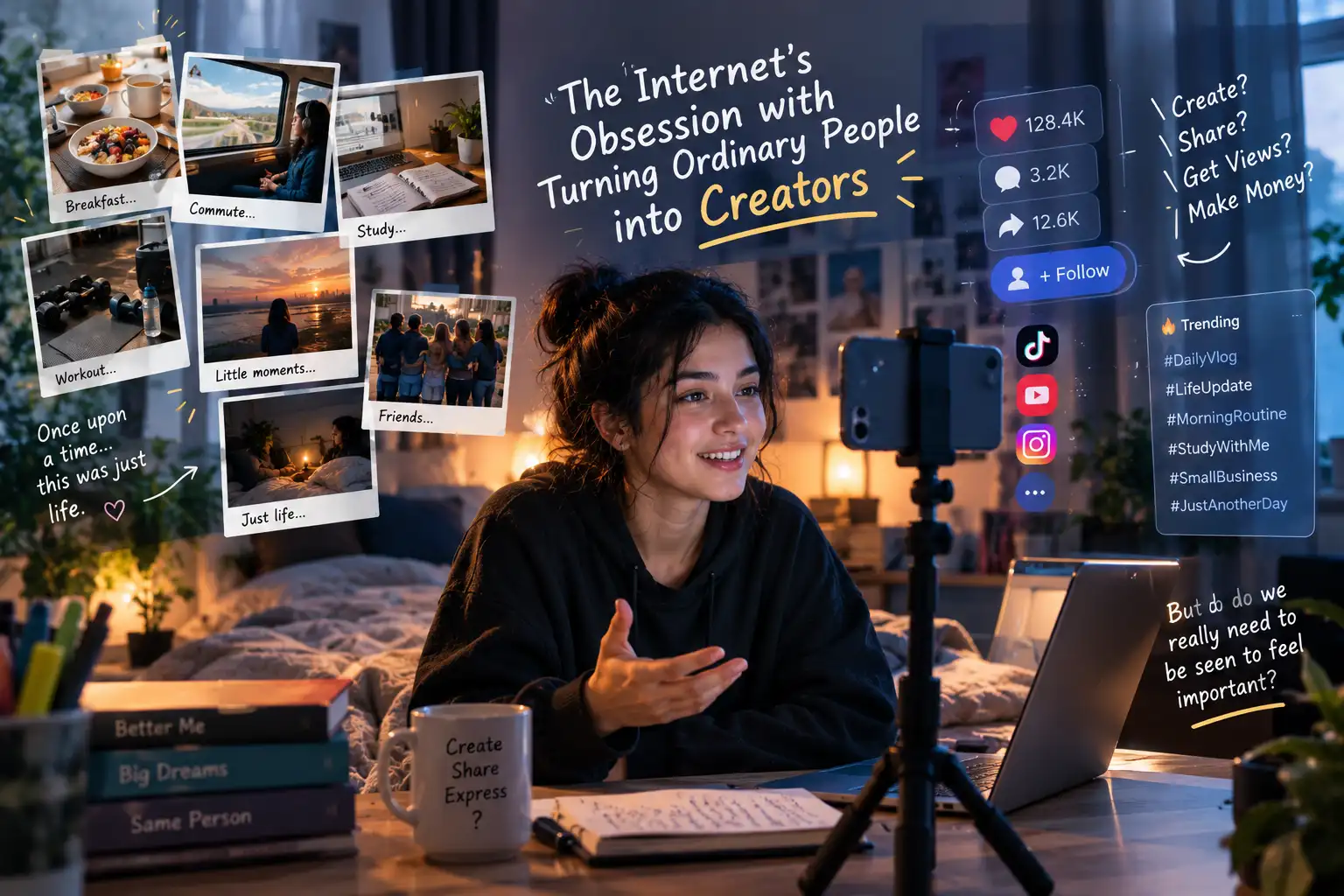
There was a time when sharing your life with the world meant becoming a celebrity, appearing on television, or getting your work published in a newspaper or magazine. Most people lived their lives without expecting strangers to watch them. Today, things have changed. A student recording a video in their bedroom, a person sharing their morning routine, or someone talking about an ordinary day can attract thousands of viewers. The internet has transformed everyday life into something that can be watched, shared, discussed, and sometimes even monetised. Being a creator is no longer an unusual profession. It has become an aspiration for millions of ordinary people.
But why is the internet so determined to turn everyone into a creator?
When Everyday Life Becomes Entertainment
One of the most interesting changes brought by social media is the way people look at ordinary experiences. Eating breakfast, travelling to college, shopping for groceries, or discussing a personal problem can now become content. Activities that once belonged entirely to private life are increasingly presented before an audience.
Platforms such as Instagram, YouTube, and TikTok have made publishing accessible to almost everyone. A person does not necessarily need expensive equipment, professional training, or connections with the entertainment industry. A smartphone and an internet connection can be enough to begin.
This accessibility has opened doors for people whose talents and stories might previously have gone unnoticed. A small-town artist can find an audience beyond their neighbourhood. A student can share educational knowledge. Someone with an unusual hobby can discover a community of people with similar interests.
However, this freedom has also created a strange expectation: if something happens in your life, perhaps you should record it. An experience can begin to feel incomplete unless it produces a photograph, video, or story worth sharing.
The Algorithm Behind the Obsession
Social media platforms do not simply provide spaces for creativity; their recommendation systems influence what people choose to create. Content that attracts attention, encourages interaction, or keeps viewers watching may receive greater visibility.
For aspiring creators, this can become an endless experiment. They try different video formats, follow popular trends, study successful accounts, and change their presentation according to audience reactions. Gradually, the question changes from “What do I want to share?” to “What will people watch?”
The problem is not that people enjoy attention. Human beings have always wanted recognition and appreciation. The difference is that digital platforms provide constant measurements of that attention through views, likes, comments, shares, and follower counts.
These numbers can make creativity feel like a competition. Someone who once enjoyed photography might begin taking pictures mainly because certain images perform well. Another person may feel disappointed when a carefully prepared video receives little attention, even if creating it was personally meaningful.
The algorithm does not necessarily understand the value of an experience to the person who lived it. It responds to patterns of engagement. Yet creators can gradually learn to judge their own work using the same measurements.
The Dream of Becoming Someone
For many young people, becoming a creator represents more than gaining followers. It offers the possibility of independence, financial opportunity, recognition, and an escape from conventional career paths.
Traditional industries often require qualifications, experience, or access to established networks. Online platforms appear to offer a different route. A person can start from home, develop a skill publicly, and potentially build a career around their interests.
There are genuine opportunities here. Creators can teach, entertain, document social issues, promote small businesses, and build communities. Some earn a living from their work, while others use their online presence to discover professional opportunities.
However, the internet often makes success look easier and more immediate than it is. People see the successful video but rarely see the countless unsuccessful attempts behind it. They notice the sponsorship but may not see the hours spent planning, editing, responding to comments, and maintaining an audience.
When success stories dominate the screen, ordinary employment can begin to look uninteresting, and a quiet life can seem like a life without ambition. The pressure to become visible can make people forget that there are many meaningful ways to live without building a public identity.
The Disappearance of Private Moments
Perhaps the most complicated consequence of this creator culture is the changing relationship between personal experience and privacy.
When people become accustomed to documenting their lives, they may begin to experience moments with an imaginary audience in mind. A celebration becomes an opportunity for photographs. A difficult day becomes a possible story. Even personal growth can turn into a series of updates intended to demonstrate progress.
Sharing these experiences is not automatically harmful. Personal stories can comfort others and create valuable connections. The concern arises when people feel unable to enjoy an experience without presenting it to someone else.
There is also a difference between choosing to share something and feeling that sharing is necessary to remain relevant. When every moment appears to have content potential, privacy can begin to feel like a missed opportunity rather than a personal choice.
Not everything meaningful needs an audience. Some conversations are valuable because they remain between friends. Some achievements feel complete without public congratulations. Some memories become special precisely because nobody was recording them.
Creativity Should Be a Choice, Not an Obligation
The internet has given ordinary people extraordinary opportunities to express themselves. It has challenged traditional ideas about who deserves an audience and allowed unfamiliar voices to reach people across geographical and social boundaries.
That transformation deserves appreciation. The problem begins when the opportunity to create becomes an expectation to perform.
A person should be able to make videos without becoming an influencer, enjoy photography without building a portfolio, and share opinions without turning every thought into a public statement. Creativity should expand personal freedom, not reduce life to a continuous production schedule.
Perhaps the real question is not whether everyone can become a creator, but whether everyone needs to.
The internet will continue to reward visibility, and new platforms will probably introduce even more ways to publish everyday experiences. Still, individuals can decide how much of their lives they want to make public.
Being ordinary is not a failure of imagination. Living quietly does not mean having nothing to say. And a moment does not lose its value simply because nobody else sees it.
In a world increasingly fascinated by turning people into content, preserving the freedom to live without performing may become one of the most important forms of independence.