




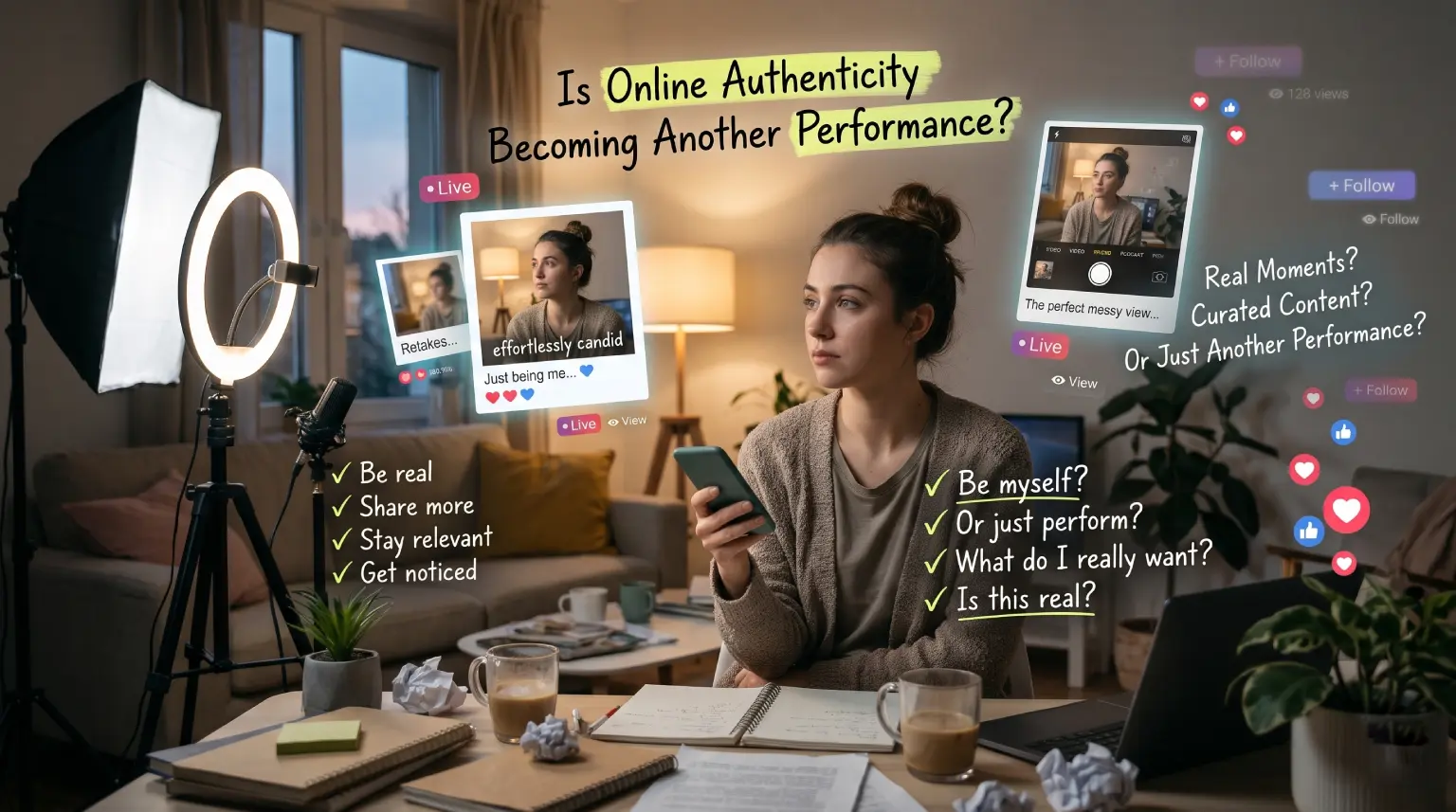
We often hear people say, “Just be yourself.” On social media, however, being yourself has started to look surprisingly complicated. People share their daily routines, talk openly about their struggles, post unfiltered photographs, and discuss personal experiences to show the world who they really are. Yet, behind many of these seemingly natural moments, there may be careful planning, repeated takes, and the desire to create a particular impression. This raises an interesting question: when everyone is trying to appear authentic online, are we turning authenticity into another performance?
The Pressure to Be Real
Social media was initially seen as a way to connect with people, share experiences, and express ourselves beyond the limits of our immediate surroundings. Today, it has also become a space where people constantly present versions of their identities. A photograph, a caption, a short video, or even a simple comment can influence how others perceive us.
The pressure is no longer limited to looking attractive, successful, or happy. People are also expected to look natural, humble, relatable, and honest. A perfectly edited photograph might receive criticism for appearing artificial, while an unedited picture may attract attention for looking genuine. Even imperfection has become something people can display to gain approval.
Consider someone recording a video about having a difficult day. They might genuinely want to express their feelings. However, they may also spend time choosing the right words, adjusting the lighting, and deciding which parts of the experience to share. The final video might be honest, but it is also carefully presented. The distinction between expressing oneself and performing for an audience becomes difficult to identify.
When Imperfection Becomes a Trend
One of the most interesting changes in internet culture is the growing popularity of content that appears imperfect. Messy rooms, unplanned photographs, awkward moments, personal failures, and emotional conversations are frequently shared as signs of authenticity.
There is nothing inherently wrong with sharing these experiences. In fact, honest conversations can help people feel less alone. Someone discussing academic pressure, friendship problems, or professional disappointment might encourage others to speak about their own experiences.
The problem begins when imperfection becomes another standard that people feel obligated to meet. Instead of asking whether they genuinely want to share something, they may begin wondering whether it will make them appear more relatable.
A person might post a photograph with an ordinary background because it feels natural. Another might deliberately create a similar setting because that style is popular. Both photographs may look equally authentic to viewers, even though the intentions behind them are different.
This does not automatically mean that the second person is dishonest. People naturally make choices about how they present themselves. The concern is that online culture can turn even the desire to appear imperfect into something that requires effort, strategy, and approval.
The Business of Being Authentic
Authenticity has also become valuable in the creator economy. Audiences often connect more easily with creators who appear approachable rather than distant or overly polished. As a result, personal stories, candid conversations, and behind-the-scenes moments have become important parts of online content.
For creators, this creates a complicated situation. They may want to share their genuine personalities while also maintaining an audience, meeting expectations, and earning an income. Their personal identity can gradually become connected to the kind of content people expect from them.
Imagine a creator who regularly discusses everyday struggles. Followers appreciate the honesty and begin expecting more personal updates. Over time, the creator might feel pressure to share private experiences even when they would prefer to keep them to themselves.
Something that began as a voluntary expression can slowly become an obligation.
Research on social media self-presentation has examined this tension between appearing authentic and carefully managing how others perceive us. A 2025 review in the Journal of Communication discusses how authenticity can become intertwined with audience expectations, social norms, and commercial interests. The issue is not simply whether someone is telling the truth, but also how the idea of being genuine is shaped by the environment in which they share their lives.
When authenticity becomes a strategy for attracting attention, the question changes from “Am I being honest?” to “Does my honesty look convincing?”
Likes, Comments, and the Need for Approval
The reaction to a post can influence how people choose to present themselves in the future. A personal story that receives supportive comments may encourage someone to share more. A sincere opinion that attracts criticism may lead them to become more cautious.
Gradually, people can begin adjusting their online identities according to what receives approval. They may avoid opinions that could cause disagreement, hide experiences they consider embarrassing, or present their emotions in ways that are easier for others to understand.
This creates a subtle contradiction. Social media gives people opportunities to express themselves, yet the response from an audience can influence what they feel comfortable expressing.
The pressure can be especially confusing for young users who are still discovering their identities. They may begin to associate acceptance with presenting a version of themselves that others find interesting, attractive, or relatable.
When every expression receives a reaction, silence can start to feel uncomfortable. Even an ordinary experience may seem less meaningful if it cannot be turned into something worth sharing.
Authenticity then becomes less about understanding oneself and more about receiving confirmation from others.
Does Sharing Everything Make Us More Authentic?
There is a common assumption that being authentic means sharing everything openly. If someone discusses personal difficulties online, they may be praised for their honesty. If someone chooses privacy, they may be perceived as distant or secretive.
But these assumptions overlook an important fact: honesty does not require complete public access to a person’s life.
Someone can be genuine without explaining every disagreement, documenting every emotion, or turning a difficult experience into a public story. A private moment does not become less meaningful simply because nobody else witnesses it.
People also have different reasons for protecting their privacy. Some may need time to understand their emotions before discussing them. Others may prefer to share personal matters with a small circle of trusted people. Neither choice automatically makes them less authentic.
In fact, the freedom to decide what remains private may be an important part of being genuine. If people feel compelled to reveal personal information to prove that they are real, authenticity itself becomes restrictive.
Being honest should be a choice, not a performance that an audience demands.
Finding a More Honest Relationship with Social Media
The answer is not to stop sharing personal experiences or to assume that every carefully edited post is fake. A photograph can be planned and still capture a meaningful moment. A creator can earn money while genuinely caring about their audience. A person can enjoy positive feedback without making their entire identity dependent on it.
The more useful approach is to recognise the difference between expressing ourselves and constantly evaluating ourselves through other people’s reactions.
Before sharing something, we can ask a simple question: would this moment still matter to me if nobody liked, commented on, or reposted it?
The answer does not have to be yes every time. Social media is a place for communication, and wanting a response is perfectly natural. What matters is whether the need for approval begins to control what we say, what we hide, and how we understand ourselves.
We also need to become more thoughtful audiences. Instead of demanding constant openness from creators and friends, we can respect their boundaries. Instead of assuming that every polished post is dishonest, we can acknowledge that online communication always involves some degree of selection.
Authenticity is not necessarily the absence of editing. It is the willingness to remain connected to our actual values, feelings, and experiences while making choices about how we present them.
Conclusion
Online authenticity is becoming another performance in some corners of social media, but that does not mean genuine expression has disappeared. It means that the desire to appear real can sometimes become entangled with the desire to be noticed.
The irony is that people may spend so much time proving their authenticity that they forget they do not need to prove it constantly. Not every thought needs a caption, not every struggle needs an audience, and not every ordinary moment needs to become content.
Perhaps the most authentic thing we can do online is allow ourselves to be inconsistent, imperfect, private, and occasionally uninteresting. We can share what matters to us without turning every part of our lives into a public statement.
After all, being real should not require a carefully constructed image of what realness looks like. It should leave us free to live our lives, even when nobody is watching.