




There was a time when people experienced life first and talked about it later. A birthday was about cutting a cake with family, a trip was about discovering a new place, and a sunset was simply something beautiful to watch. Today, things often happen differently. Before enjoying a moment, many people think about how it will look on Instagram, what caption would suit it, or whether it is worth sharing online. Slowly, life has become more than something we experience. It has become something we create content from.
Social media has changed the way we see ordinary experiences. A cup of coffee is no longer just a drink; it can become an aesthetic photograph. A walk in the rain can turn into a reel, and a personal achievement can become a carefully written LinkedIn post. Even simple activities, such as studying, cooking, travelling, or spending time with friends, can feel incomplete without a picture or video. Sharing these moments is not necessarily a bad thing, but it raises an interesting question: are we living our experiences, or are we constantly preparing them for an audience?
The Pressure to Capture Everything
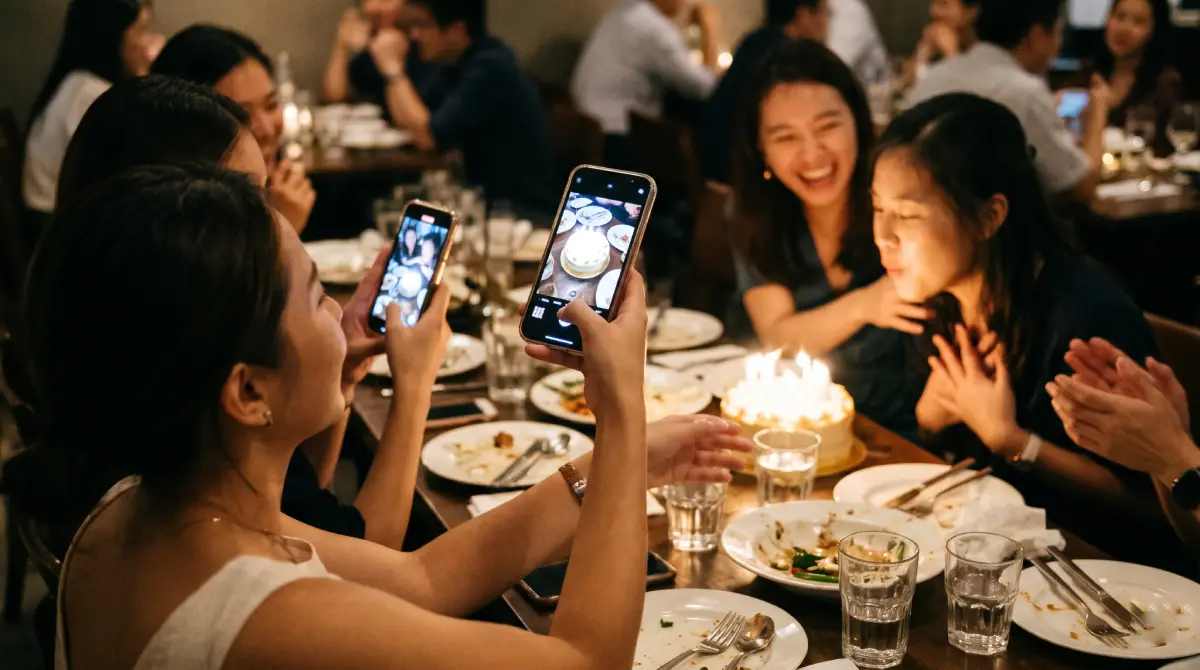
One of the biggest changes brought by social media is the feeling that every special moment should be recorded. People take photographs during celebrations, film concerts instead of watching the performers, and pause conversations to capture the perfect picture. Sometimes, the camera becomes more important than the experience itself.
This behaviour is understandable. Photographs help us remember people, places, and feelings that might otherwise fade with time. Social media also allows us to share happiness with friends and family who live far away. However, when recording a moment becomes an obligation, something meaningful can turn into a task.
Imagine watching a beautiful sunset. Instead of enjoying its colours, you spend several minutes searching for the right angle, adjusting the brightness, and deciding whether the picture looks good enough to post. By the time you finish, the sun has disappeared. You have a photograph of the sunset, but you may have missed the experience of watching it.
When Memories Need an Audience
Another interesting aspect of online life is how often we connect our memories with other people’s reactions. Likes, comments, shares, and views can make us feel appreciated. A photograph that receives hundreds of likes may seem more valuable than one that receives only a few, even when both capture equally meaningful experiences.
This can quietly change our understanding of happiness. Instead of asking ourselves whether a moment made us happy, we may begin wondering whether it will make an interesting post. A celebration may feel less exciting if nobody notices it online. A personal achievement may seem incomplete without public appreciation.
Of course, sharing achievements and receiving encouragement can be wonderful. The problem begins when external reactions become the main measure of our experiences. Not every meaningful thing needs to be witnessed by strangers. Some memories can remain beautiful without becoming public property.
The Performance of an Ordinary Life
The internet has also created a space where ordinary life can feel like a continuous performance. People often share carefully selected photographs, organised workspaces, exciting holidays, and successful moments. What appears online may be genuine, but it is rarely the complete picture.
Behind a perfect photograph might be several failed attempts. Behind a productive morning routine might be an exhausting week. A happy-looking group picture cannot explain everything happening within the relationships it represents.
When we repeatedly see these edited versions of other people’s lives, we may begin comparing our everyday reality with their carefully selected highlights. Our ordinary afternoons can start feeling boring, and our achievements may seem smaller than they really are.
The irony is that the moments we consider too ordinary to share are often the ones we remember most fondly later: a family member telling an old story, a friend laughing at a silly joke, or an unexpected conversation on the way home.
Finding the Balance
The answer is not to stop creating content or abandon social media completely. Digital platforms have given people opportunities to express themselves, build communities, document important events, and even earn a living. For artists, writers, journalists, and creators, turning experiences into content can be meaningful work.
What matters is learning to recognise the difference between sharing a moment and depending on sharing it to enjoy it.
Sometimes, we can leave our phones in our pockets during a conversation. We can watch a performance without recording the entire thing. We can celebrate an achievement before announcing it online. We can also enjoy a beautiful place without worrying about whether it will look impressive in photographs.
These small choices remind us that we do not owe the internet constant access to our lives. Our experiences have value even when nobody sees them.
Life Beyond the Screen
Perhaps the most beautiful moments are not always the ones that look good on a screen. They are the unexpected, imperfect experiences that happen without planning: laughing until we forget what started the joke, getting lost while exploring a new place, or sitting quietly with someone who understands us without words.
Not every moment needs a caption, and not every memory needs an audience. Some experiences become more meaningful precisely because we allow ourselves to be completely present in them.
In a world where almost anything can become content, choosing to experience something privately can be a small but powerful decision. The purpose of life is not to produce an endless collection of posts. It is to build a collection of experiences that matter to us, whether anyone else ever sees them or not.
Because sometimes, the best moments are the ones we never think to record.