



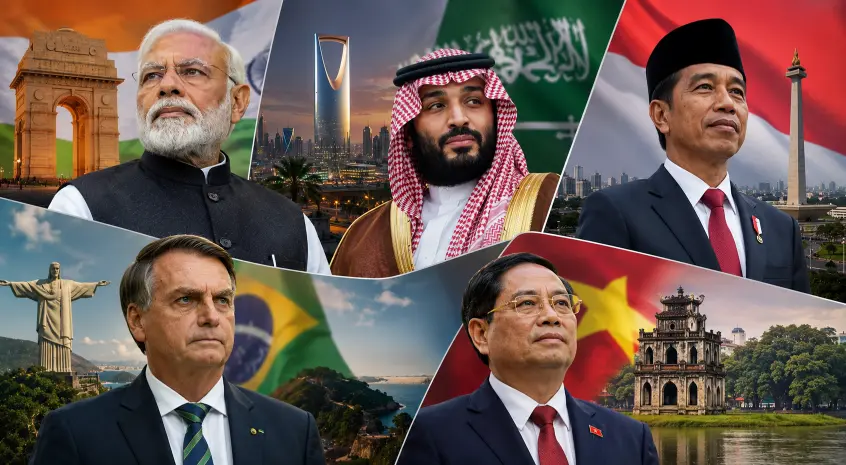
For the longest time, the idea of a “global superpower” felt predictable. The United States led the West, China became the manufacturing engine of the world, and Europe maintained influence through finance, diplomacy, and trade. Most conversations around global power rarely moved beyond those names.
But the world is changing faster than many expected.
A new group of countries is slowly building influence in ways that don’t always make front-page headlines. They are investing heavily in infrastructure, attracting global companies, building digital economies, strengthening trade relationships, and preparing for a future where influence is measured by far more than military strength alone.
Today, economic resilience, technology, supply chains, energy, and access to resources matter just as much as traditional geopolitical power. And in that race, a few countries are positioning themselves surprisingly well.
India Is Becoming Impossible to Ignore
India’s rise has been talked about for years, but the difference now is that the momentum feels real.
The country is no longer seen only as a massive consumer market or an outsourcing destination. It is increasingly becoming central to how global businesses plan their future. Companies looking to reduce dependence on China are expanding manufacturing operations in India, particularly in electronics, smartphones, and renewable energy.
At the same time, India’s digital growth has been remarkable. The speed at which services like UPI transformed payments changed how millions of people interact with money every day. Small businesses, street vendors, and startups now operate in a digital-first environment that barely existed a decade ago.
What makes India particularly interesting is its demographic advantage. While countries like Japan, South Korea, and several European economies are dealing with aging populations, India still has a large young workforce entering the economy every year.
That doesn’t automatically guarantee success, of course. India still faces major challenges around infrastructure, employment, and urban development. But the scale of opportunity is difficult for the world to ignore anymore.
Saudi Arabia Wants to Become More Than an Oil Economy
For decades, Saudi Arabia’s global influence came almost entirely from oil. That story is now changing.
The kingdom is investing aggressively in sectors that would have seemed unexpected just a few years ago. Technology, tourism, entertainment, sports, artificial intelligence, and renewable energy are all becoming part of its long-term economic strategy.
Projects like NEOM often attract attention online because of their futuristic ambitions, but the broader shift happening inside Saudi Arabia is far more significant. The country is trying to redesign its entire economic identity for a post-oil future. Its investment influence is also expanding globally. Saudi-backed funds are now involved in everything from international sports leagues to tech companies and infrastructure projects around the world.
Whether every ambitious project succeeds or not, one thing is clear: Saudi Arabia is preparing for a future where its influence goes well beyond energy markets.
Indonesia Could Become Southeast Asia’s Biggest Surprise
Indonesia rarely gets discussed alongside countries like China or India, but its growth story deserves more attention.
It already has the largest economy in Southeast Asia, and its importance is increasing because of something the modern world desperately needs: resources.
Indonesia holds some of the world’s largest nickel reserves, which are essential for electric vehicle batteries. As the global push toward EVs and clean energy accelerates, countries rich in critical minerals are becoming strategically valuable in entirely new ways.
Beyond resources, Indonesia’s digital economy is expanding quickly. E-commerce platforms, fintech startups, and online services are growing across the country as internet access and smartphone usage continue rising.
Its location also matters. Sitting along some of the world’s most important maritime trade routes gives Indonesia long-term geopolitical significance that many analysts believe is still underestimated.
Brazil Still Has Untapped Potential
Brazil has often been described as “the country of the future,” sometimes so often that the phrase lost meaning.
But global trends may finally be shifting in Brazil’s favor.
The world is becoming increasingly focused on food security, renewable energy, and sustainable resources. Brazil happens to be strong in all three areas. It is already one of the world’s largest agricultural exporters, and its renewable energy capabilities give it advantages many countries are still trying to build.
Brazil also benefits from something many nations lack: scale. Its domestic market is huge, its natural resources are extensive, and its regional influence in Latin America remains significant.
Political instability and economic uncertainty have slowed progress in the past, and those risks still exist. But if Brazil manages to maintain long-term economic consistency, it has the potential to become far more influential globally than it is today.
Vietnam’s Growth Has Been Quiet but Consistent
Vietnam’s rise has been one of the clearest examples of how global supply chains are changing.
As companies diversify manufacturing away from China, Vietnam has become a preferred alternative for many industries, particularly electronics and apparel. Major global brands have expanded production there because of competitive labor costs, improving infrastructure, and strong export capabilities.
What stands out about Vietnam is how steadily it has grown without constantly dominating international headlines.
Foreign investment has increased year after year, exports continue to rise, and the country has positioned itself as an increasingly important manufacturing hub in Asia.
In many ways, Vietnam reflects a larger global trend. Future economic influence may not belong only to massive economies. Smaller countries with strategic positioning, stable growth, and strong trade relationships are becoming equally important.
The Definition of a Superpower Is Changing
The next generation of global powers may not look like the ones that came before them.
The future is unlikely to revolve around one country dominating every industry or region. Instead, influence is becoming more distributed. One country may lead in technology, another in manufacturing, another in energy, and another in natural resources.
That shift is already visible.
Countries that are adapting quickly to technological change, investing in infrastructure, and building stronger economic ecosystems are quietly gaining influence while much of the world still focuses on traditional powers.
The most interesting part is that many of these transformations are still in their early stages.
A decade from now, the countries that currently seem like “emerging markets” may no longer be viewed that way at all. They may simply become the countries shaping how the global economy works.