





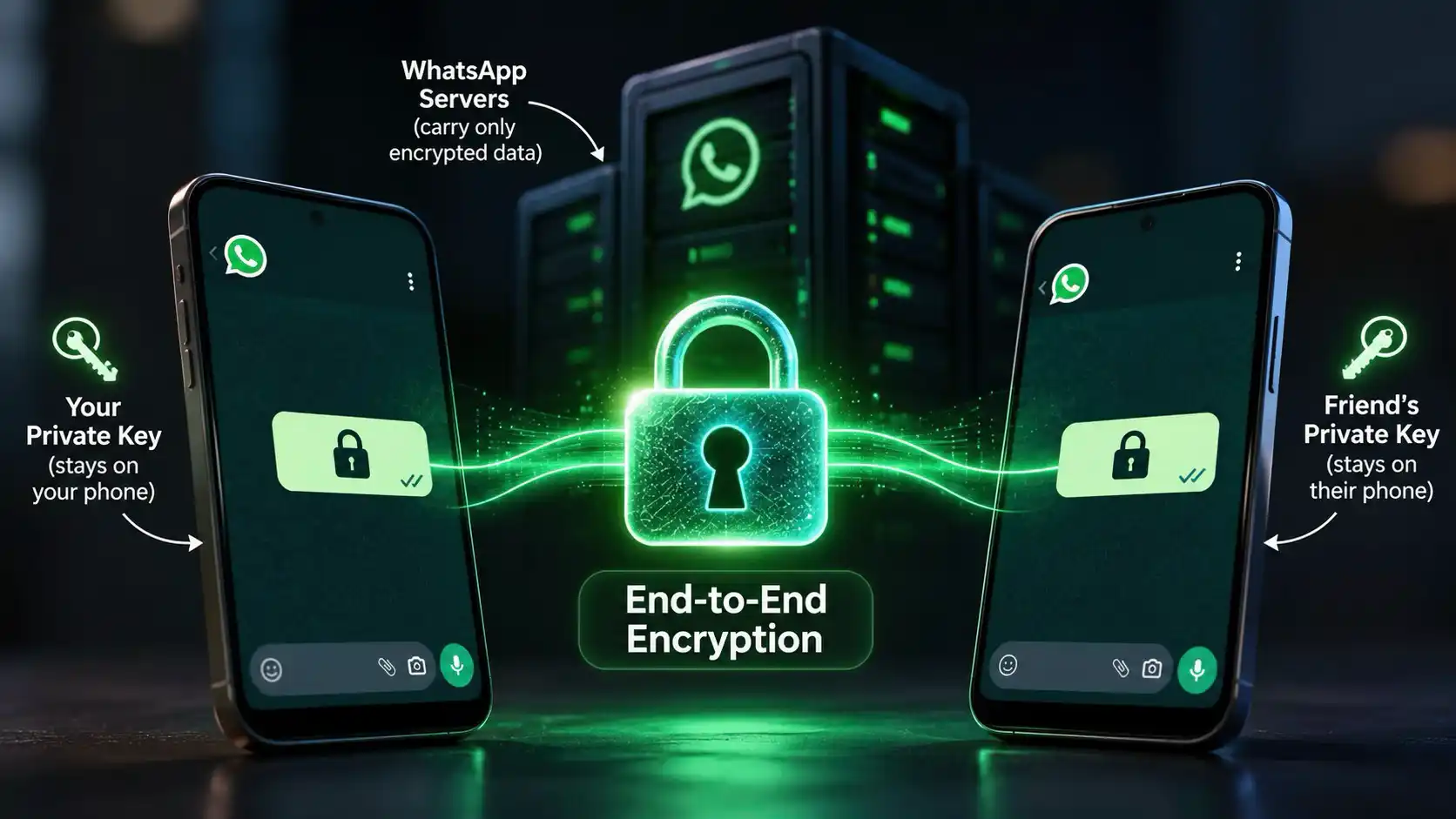
A message on WhatsApp crosses company servers on its way to your friend, yet the company says it cannot read it, and the reason is that the key never travels with the message
Every day, billions of messages hop through servers owned by a handful of firms. The promise of end-to-end encryption is that those firms carry the messages without being able to read them. It sounds like a contradiction until you see how the lock is built.
The Problem With Sending a Secret
Two people who want to talk privately face an old puzzle. If they agree on a secret code, they must share it first, and sharing it over a channel someone is watching defeats the purpose. For centuries the answer was to meet in person and swap the code. That is no use when you are chatting with a cousin in another country or a stranger you met online.
Two Keys Instead of One
Modern encryption solves it with a pair of keys. Think of a public key as an open padlock that you hand out to anyone. Your private key is the only thing that can open the lock once it is closed, and it never leaves your phone. A friend who wants to write to you snaps your padlock shut around the message. After that, even the friend cannot reopen it. Only you can.
Building a Shared Secret in Plain View
Chat apps go one step further. Using a method called a key exchange, the two phones each combine their own private number with the other’s public number and end up holding the same secret, even though that secret was never sent. A common way to picture it is mixing paint: two people each add a private colour to a shared base colour and swap the results. Each then adds their own colour again, and both end up with the same final shade. Anyone who watched the swap sees only the mixed paints and cannot work backwards to the private colours.
A Fresh Key Every Time
WhatsApp uses a design called the Signal Protocol, created by cryptographers working with the Signal app. It changes the encryption key with every message, using a technique known as a double ratchet. The benefit is called forward secrecy. If someone steals a key today, it unlocks only one message, not the months of history that came before. WhatsApp finished rolling this out to all its users in 2016.
What the Server Still Sees
A message that cannot be read can still leave tracks. The service knows which accounts are talking, when messages are sent and roughly how large they are. That information, called metadata, is not hidden by the encryption itself. Whether it is stored, for how long and who can ask for it depends on the company’s policies and local law, not on the lock.
Where the Lock Can Be Bypassed
The word “end” refers to the phones, and that is exactly where attacks happen. Anyone holding your unlocked phone can read your chats. Someone who tricks you into installing malware can see messages as they appear on screen. Cloud backups have been another weak point, because a backup stored without its own encryption can be opened by whoever holds the account. WhatsApp added an option for encrypted backups in 2021, but it must be switched on.
Making Sure You Are Talking to the Right Person
An encrypted chat is only secure if the person at the other end is who you think. Apps therefore offer a security code, a string of digits or a QR code that both people can compare in person or over another channel. If the two match, no one has slipped into the middle. The app can also alert you when a contact’s code changes, which can happen innocently when they get a new phone, but is worth checking if it happens unexpectedly.
The Policy Argument
The same technology has become a point of friction between messaging companies and the Indian government.. The IT Rules of 2021 require large messaging platforms to be able to identify the first sender of a message when authorities demand it. WhatsApp challenged that requirement in the Delhi High Court soon after, arguing that tracing a message to its origin would mean weakening the encryption for everyone. The government’s position is that serious crimes need a way to be traced. The two sides are arguing over the same technical point: whether a platform that cannot read messages can still say who started a chain.
Three Small Habits That Matter
Most real-world protection comes from settings, not mathematics. Turn on encrypted backups if your app offers them. Keep your phone locked with a strong passcode. Enable the alert that tells you when a contact’s security code changes. None of them takes a minute, and together they cover the places where the lock itself cannot help.