





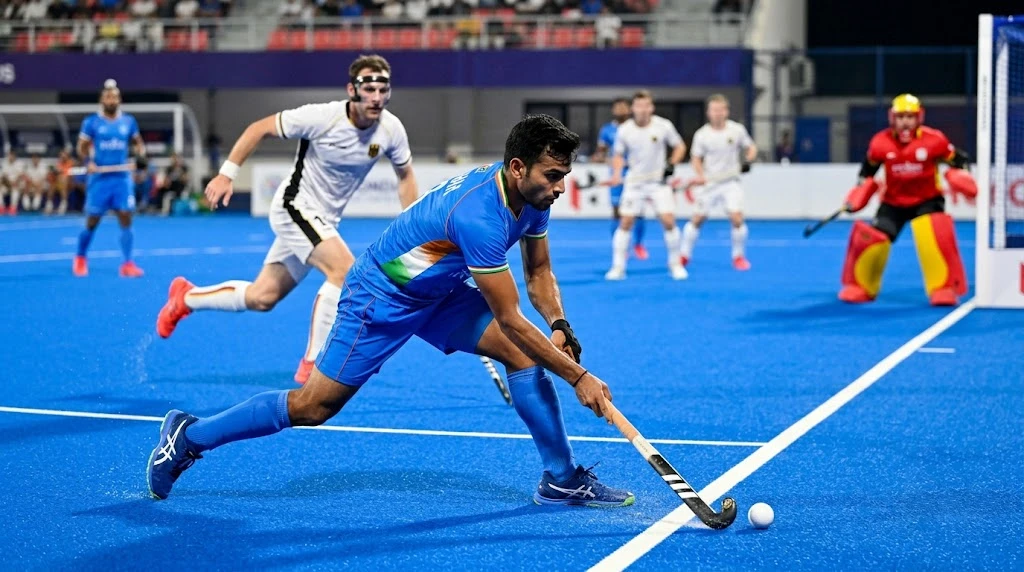
Behind every penalty corner goal is a choreographed routine of five defenders, one goalkeeper and a specialist who has spent years perfecting a single movement
A penalty corner looks simple from the stands. A player pushes the ball in from the baseline, another stops it, and a third shoots. In reality it is the most rehearsed passage of play in hockey, and the shooter’s technique, the drag-flick, has become the skill that separates teams that win medals from teams that merely compete.
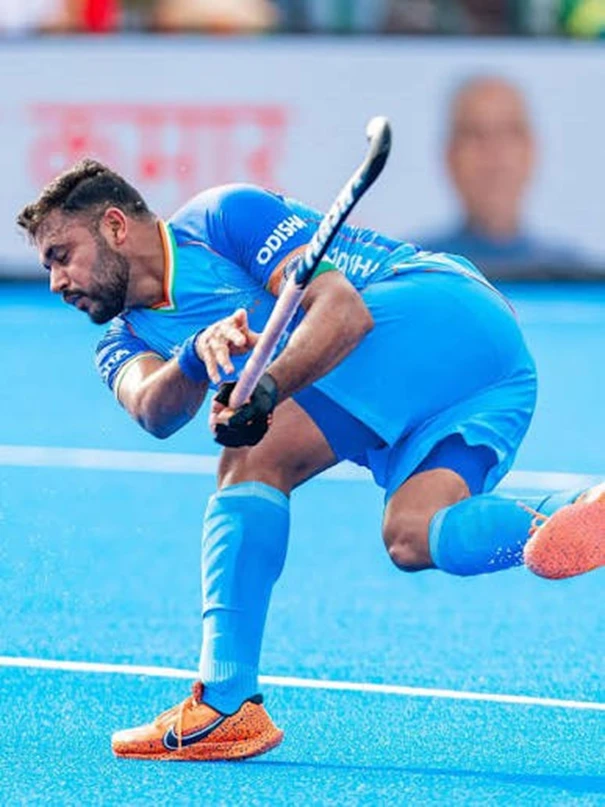
Harmanpreet Singh executes a drag-flick during a penalty corner for the Indian men’s hockey team
Anatomy of a Penalty Corner
The routine begins when the attacking team injects the ball from the baseline, at a point at least ten metres from the nearest goalpost. Defenders are limited to five behind the line, goalkeeper included, while the rest of their team waits beyond the halfway line until the ball is played. The attacking team must stop the ball and bring it out to the edge of the shooting circle, whose radius is 14.63 metres, before anyone can shoot. This gives the defence a few seconds to organise and the attack a few seconds to execute whatever they have practised.
What Makes the Drag-Flick Different
A conventional hit relies on a backswing and a big, visible strike. The drag-flick compresses that into something far more deceptive. The shooter steps toward the ball, drags it along the turf in a sweeping arc across the body while keeping the stick in contact, and loads the stick like a spring. At the last instant the wrists and forearms release and the ball is flicked off the ground toward the goal.
The result is a shot that leaves the stick low and fast with very little warning. Goalkeepers often say the shooter’s stance tells them more than the ball does, because by the time the ball moves there is almost no time to react. Players who master it can also vary the height and the corner of the goal they target, which is why a team with a reliable flicker puts pressure on every defence it faces.
A Dependence India Has Learned to Embrace
India has produced a line of specialists, from Sandeep Singh, nicknamed Flicker Singh, to Rupinder Pal Singh, and now Harmanpreet Singh. At the Paris Olympics, Harmanpreet scored 10 goals in eight matches, the most in the tournament and three more than the next best scorer. He also scored both goals in the bronze medal win over Spain, which secured India’s second consecutive Olympic bronze and its first back-to-back medals since 1972.
That reliance has a cost as well as a benefit. When one player scores so much, opponents can plan specifically for him. Defenders will try to rush early, force him to alter his run-up or block the angle he prefers, and coaches therefore need alternative routines to keep teams guessing.
The Craft of Beating the Rusher
This is why modern penalty corners rarely end with a straight flick. Teams practise variations in which the stopper passes to a second player, the ball is slipped to the side or a deflection is attempted at the post. A defender who commits to the rush can be beaten by a quick change of direction, and the best attacking units treat the drag-flick as one option within a menu rather than the only plan.
Defenders have adapted as well, wearing face masks and pads and drilling their own routines to close down space within a fraction of a second. Goalkeepers train specifically for the low, hard shot, learning to stay big and wait rather than dive early.
What to Watch for Next Time
The next time India wins a penalty corner, watch three things before the shot is taken. First, how many defenders are committed to the rush. Second, where the shooter places his feet when the ball arrives. Third, whether the stopper’s trap creates any hesitation. Most goals from a penalty corner are decided in those moments, before the flick even begins.