





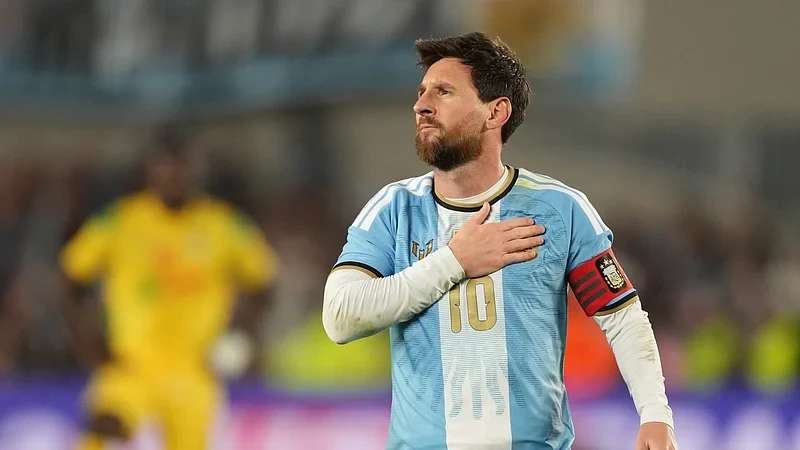
There are some football matches that begin long before the referee blows the whistle, Lionel Messi’s final game for Argentina was one of them. By the time the lights of Buenos Aires fell across the Monumental Stadium on October 6, the match had already become a memory in the making. More than 85,000 people filled the stadium, not simply to watch Argentina play Benin, but to witness the final appearance of a man who had worn the famous blue-and-white shirt for 21 years. Outside the stadium, fans gathered in tears. Inside, thousands of voices waited for the familiar sight of the No. 10 walking onto the pitch one last time.
Normally football is about the future; the next match, the next tournament, the next goal. But that evening, everyone knew exactly what they were watching; there would be no next Argentina match for Messi.
The 39-year-old captain had reached the final page of a story that began when he was a teenager, and maybe that’s why even the smallest moments felt enormous.
When Messi appeared for the warm-up, the Monumental erupted. When the national anthem played, the atmosphere became heavier and when the match reached the 10th minute, play was stopped so the crowd could rise and applaud their No. 10. For a few moments, the football disappeared completely. There was only a stadium full of people saying thank you.Then, eventually, the game began.And Messi did what Messi has done for more than two decades.
He played.
The opposition was Benin, the match was a friendly, and there was no trophy waiting at the end of the night. Yet Messi’s presence gave the game a significance that its competitive importance could never have provided.
Argentina eventually won 3-0.
Nicolás Otamendi opened the scoring, Nico Paz added another and, with the result already secure, Messi stepped forward for the moment everyone had been waiting for.
A penalty.
One final chance to send the ball into the net wearing Argentina’s colours.
Messi scored.
His 126th international goal.
His 208th and final appearance for Argentina.
And suddenly, the ending seemed almost impossibly perfect.
But Messi’s story with Argentina has never really been about numbers.
For a longer part of his international career, the numbers were actually used against him. He had won almost everything imaginable at club level, but every time he returned to Argentina, the conversation changed. The country did not merely want Messi to be brilliant. It wanted him to win. The expectations were enormous. Argentina had Maradona. Argentina had World Cup history. Argentina had a football culture in which failure was rarely treated gently. And Messi, despite being arguably the most gifted footballer of his generation, initially could not escape the one thing that mattered most to his country: an international trophy. There were finals lost. There were missed opportunities. There were moments when the weight of expectation seemed almost visible on his shoulders. At one point, after another painful defeat, Messi even announced his international retirement. But football has a strange habit of giving its greatest stories another chapter.
Messi returned.
Then came 2021.Argentina defeated Brazil in the Copa América final at the Maracanã, and Messi finally had his first major senior international trophy. It was not simply a victory. It changed the relationship between Messi and Argentina.The criticism softened.The chants became warmer.The player who had once been asked why he could not win for his country was finally being celebrated for doing exactly that.A year later came the World Cup.
Qatar changed everything.
Messi led Argentina through a tournament that became one of the most dramatic World Cup campaigns ever witnessed. The final against France became a match that seemed to contain an entire career within 120 minutes and a penalty shootout.When Argentina eventually lifted the trophy, Messi had completed the one dream that had followed him throughout his career.The little guy from Rosario who had left as a teenager had returned as a world champion.And that is what made his final night so emotional.The story was already complete.He did not need to score against Benin.He did not need another trophy.He did not need to prove that he belonged among football’s greatest.Yet he still produced one final performance.
One goal,two assists.A 3-0 victory.
It was almost as if Messi had refused to leave quietly.
The final whistle did not immediately end the evening. Instead, the stadium transformed into a celebration. Fireworks filled the sky, Argentina’s colours illuminated the surroundings, and singer Soledad Pastorutti performed as part of the farewell. Messi stood before the crowd, visibly emotional, surrounded by teammates and supporters who had spent years watching his journey unfold.There was also something deeply symbolic about the younger players sharing the field with him.
Messi had been the future of Argentine football for many years, then he became its present and now he has become its past — and its history. Players such as Nico Paz represent the generation that must eventually carry Argentina forward. They will not replace Messi. Nobody really can. What they inherit is something different: the standard he established. The expectation to play with courage. The responsibility of wearing the shirt. The knowledge that millions of people can attach memories to a single footballer. That may be Messi’s greatest legacy with Argentina. Not the goals. Not the assists. Not even the trophies. It is the emotional connection.
There are children who have never known Argentina without Messi. There are adults who watched his first international appearances and then watched him lift the World Cup more than a decade later. There are fans who spent years defending him and others who eventually had to admit that the player they once questioned had become impossible to separate from Argentine football itself. That is why retirement from international football feels different for Messi. Argentina is not simply losing a footballer. It is losing a familiar presence.
For 21 years, the national team had a player everyone could look toward when the match became difficult. A pass, a run, a free kick, a moment of imagination — there was always the possibility that Messi could change the game. Now there will be no such certainty. Football will continue. Argentina will continue. Another player will eventually wear the No. 10.Another generation will create its own memories. But some eras cannot be recreated. Messi’s era is one of them.
The final night at the Monumental was therefore not really a goodbye to football. It was a goodbye to a chapter of football that millions of people grew up with. And perhaps the most fitting part of the entire evening was that Messi left exactly as he had arrived at his best moments — with the ball at his feet, the crowd watching, and Argentina believing that something beautiful might happen. This time, something beautiful had already happened. For 21 years.
And on October 6, Argentina finally had to say the words that football had been postponing for as long as possible:
Gracias, Leo.