




A power meant for emergencies sits in the Constitution, and the courts have spent decades deciding how far it can stretch
Most Indian laws are made the slow way, through bills, debates and votes in two Houses. But there is a second route, which needs only the Cabinet’s decision and the President’s signature. An ordinance carries the full force of an Act, and it can appear overnight. The power exists for a good reason and has a long history of being tested.
The Gap It Was Built to Fill
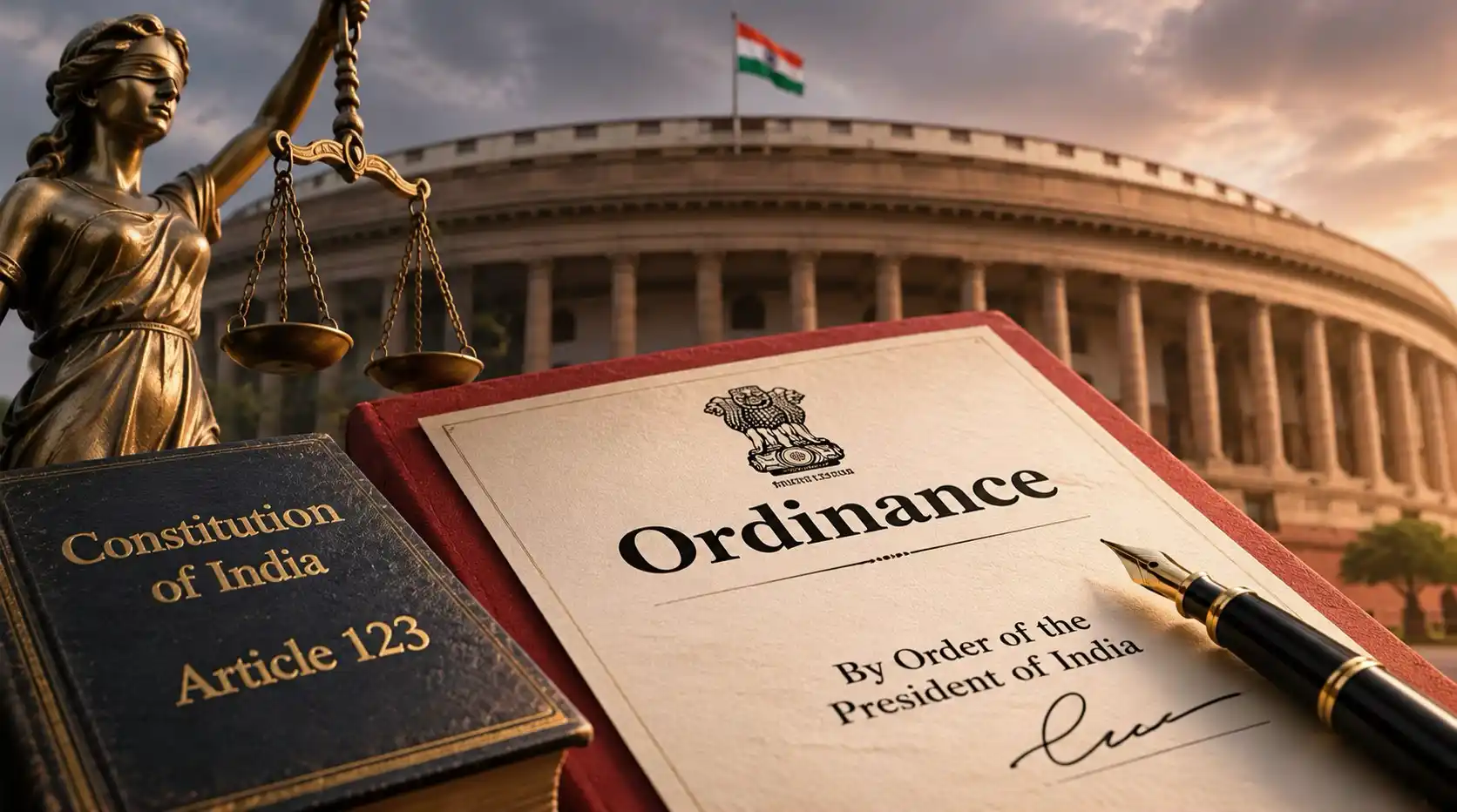
Parliament does not sit all year, and the law has to be able to change when it is not in session. Article 123 of the Constitution therefore lets the President issue an ordinance when either House is not sitting and circumstances call for immediate action. In practice, the President acts on the advice of the Union Cabinet, which means the decision belongs to the government of the day. State governors have a parallel power under Article 213, and it works the same way for state legislatures.
Limits Written Into the Text
The power is not unlimited. An ordinance may deal only with subjects on which Parliament itself can make laws. It cannot amend the Constitution. It has no standing beyond a fixed period unless the legislature backs it, and it has to be placed before both Houses once they meet again. If Parliament does not turn it into an Act, or if both Houses pass a resolution disapproving of it, it ends.
The Clock Starts Ticking
An ordinance lapses six weeks after Parliament reassembles, and if the two Houses meet on different dates, the later date counts. Suppose the Monsoon Session ends in August and a new ordinance is issued in October. If the Winter Session opens on November 25, the ordinance must be passed as a bill by early January, or it expires. Because Parliament can go six months between sittings, the longest an ordinance can stay in force before the six weeks begin is about six months, so its total possible life is a little over seven months.
When the Tool Got Misused
The first serious test came from Bihar. In the 1980s, the state government kept re-issuing the same ordinances, in some cases over many years, without ever placing them before the legislature as bills. In
D.C. Wadhwa v. State of Bihar in 1987, the Supreme Court called this a violation of the constitutional scheme and held that the executive cannot take over the role of the legislature by renewing ordinances again and again. The judges treated the habit of renewing ordinances without the legislature’s approval as a misuse of the constitutional design, since it let the executive keep making law that the elected House had never examined. A larger bench returned to the question in 2017 in Krishna Kumar Singh v. State of Bihar. It held that a government has a duty to place an ordinance before the legislature, and that repeated renewal is not a legitimate way around the requirement.
A Modern Case Study: The Farm Laws
The ordinance route shows up often in recent politics. In June 2020, the Centre issued three ordinances on agricultural trade, contract farming and stockholding. They were converted into Acts in September 2020 after a heated passage through Parliament, and then repealed in 2021 after prolonged protests by farmers. A year earlier, the sequence had also illustrated a tension that critics often raise: a measure of this scale had first appeared as an ordinance, with no debate, and its debate came only later.
The Argument For and Against
Supporters say the ordinance power is vital. Floods, wars, financial shocks or sudden court rulings can all demand a quick response that cannot wait weeks for Parliament to meet. They also note that the Constituent Assembly debated the power and kept it on purpose. Critics reply that it has drifted from emergency tool to routine shortcut, particularly when a government lacks the numbers in one House. Used that way, they say, an ordinance lets a government create a law first and ask for approval afterwards.
Watching for the Pattern
For readers, the practical test is straightforward. Check whether the ordinance deals with a genuine urgency, whether Parliament was in session shortly before or after, and whether it was converted into an Act within the six-week window. An ordinance that is replaced quickly by a bill, after real debate, is the system working as intended. One that is issued repeatedly, or that bypasses a Parliament that was sitting days earlier, is the pattern the courts have warned against.