




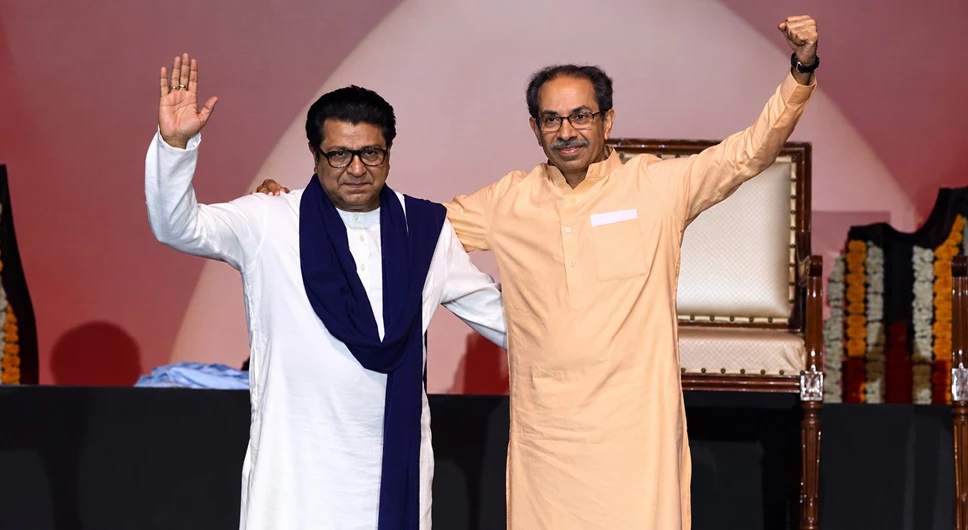
Uddhav and Raj Thackeray share a stage for the second time this year, this time marching through Mumbai to demand the Chief Election Commissioner’s resignation over a contested voter roll exercise
Political estrangement in the Thackeray family has become something of a recurring headline in Maharashtra politics over the years, which is precisely what made Sunday’s scene in south Mumbai so striking. Shiv Sena (UBT) chief Uddhav Thackeray and Maharashtra Navnirman Sena chief Raj Thackeray walked side by side through the city’s streets, leading thousands of demonstrators in a protest march aimed squarely at Chief Election Commissioner Gyanesh Kumar and the Election Commission’s handling of the ongoing Special Intensive Revision of electoral rolls.
A March Stripped of Party Colours
Named the Garjana Morcha, the demonstration began at Metro Cinema and wound its way toward the headquarters of the Brihanmumbai Municipal Corporation. Organisers made a deliberate visual choice for the day, asking participants to leave their party flags at home in favour of the national tricolour, a gesture meant to frame the protest as a civic concern rather than a partisan rally, even as its two most visible leaders carry unmistakably partisan histories.
The Process at the Centre of the Anger
At the heart of the demonstration lies the Special Intensive Revision, an electoral roll exercise the Election Commission launched nationally in October last year under Chief Election Commissioner Gyanesh Kumar, with a second phase covering nine states and three union territories formally beginning in November. The process has already produced numbers large enough to alarm opposition parties across several states, with reports indicating that close to 91 lakh voters were removed from electoral rolls in West Bengal and roughly 2.04 crore names were deleted in Uttar Pradesh during the revision period stretching from October last year to April this year.
It is precisely this scale of deletion that protesters say justifies their alarm, arguing that a process meant to clean up voter lists risks instead stripping legitimate voters of their franchise while leaving the door open to other irregularities.
Raj Thackeray’s Blunt Assessment
Addressing the gathered crowd, Raj Thackeray did not mince words about his view of the exercise, declaring the Special Intensive Revision process illegal in its entirety. He went further, alleging that the mechanism was being used to disenfranchise legitimate citizens even as fraudulent entries found their way onto the rolls, and called for an immediate halt to the process alongside a broader return to paper ballots for future elections, a demand that would mark a significant reversal of India’s long-standing shift toward electronic voting machines.
Not the First Time These Two Have Shared a Cause
Sunday’s march was notably not the first occasion this year that the Thackeray cousins have appeared together in public protest. Earlier in 2026, the two had already found common ground on the issue of Marathi linguistic pride, a rare moment of political alignment between branches of the Shiv Sena movement that split years ago and have largely operated as rivals since. Their joint appearance against the Election Commission now marks a second instance of shared political theatre in a single year, fuelling speculation in Maharashtra’s political circles about whether these occasional alliances could eventually harden into something more structural ahead of future elections.
A Grievance That Built Over Several Days
Sunday’s march did not emerge in isolation. It followed a separate demonstration held in Mumbai just a day earlier, organised by a youth-driven group calling itself the Cockroach Janata Party, which had also gathered to demand Gyanesh Kumar’s resignation over the same set of grievances. The back-to-back nature of these protests, one driven by younger, less conventionally organised activists and the other led by two of Maharashtra’s most recognisable political surnames, suggests the anger over the SIR process is cutting across generational and organisational lines within the state’s opposition landscape.
A Commissioner Under Repeated Scrutiny
This is also not the first time Gyanesh Kumar’s tenure as Chief Election Commissioner has drawn public criticism since he took office in February last year. The Special Intensive Revision itself has remained a flashpoint for opposition parties well beyond Maharashtra since its October 2025 launch, with similar objections raised in states where large numbers of voters were removed from rolls during earlier phases of the exercise.
What a Second Reunion Could Signal
Beyond the immediate demands aimed at the Election Commission, Sunday’s march carries a political subtext that may prove just as consequential as its stated cause. For a state where Shiv Sena’s split has shaped more than a decade of political manoeuvring, two public appearances by Uddhav and Raj Thackeray within the same year, on two entirely different issues, raises genuine questions about whether Maharashtra’s opposition landscape is quietly repositioning itself ahead of future electoral contests, even as both leaders continue to frame their shared appearances as responses to specific civic grievances rather than a formal political realignment.