





A viral moment that turned into a movement
In May 2026, the emergence of the Cockroach Janta Party (CJP) quickly transcended the internet trend boundaries. It started as something that was happening quickly across social media platforms, all the way to becoming a much talked-about phenomenon in the digital world, not only for its reach, but also for its satirical and political commentary. In its heyday, the movement was reported to have garnered millions of followers across platforms, with a user base mainly composed of Gen Z and millennials.
CJP was not formed as a result of organised politics or formal political campaigns as usual. It has grown organically, driven by the memes, reposts and user content that have turned it into a sort of collective cultural marker rather than a formal structure.
From insult to identity: the origin of symbolism
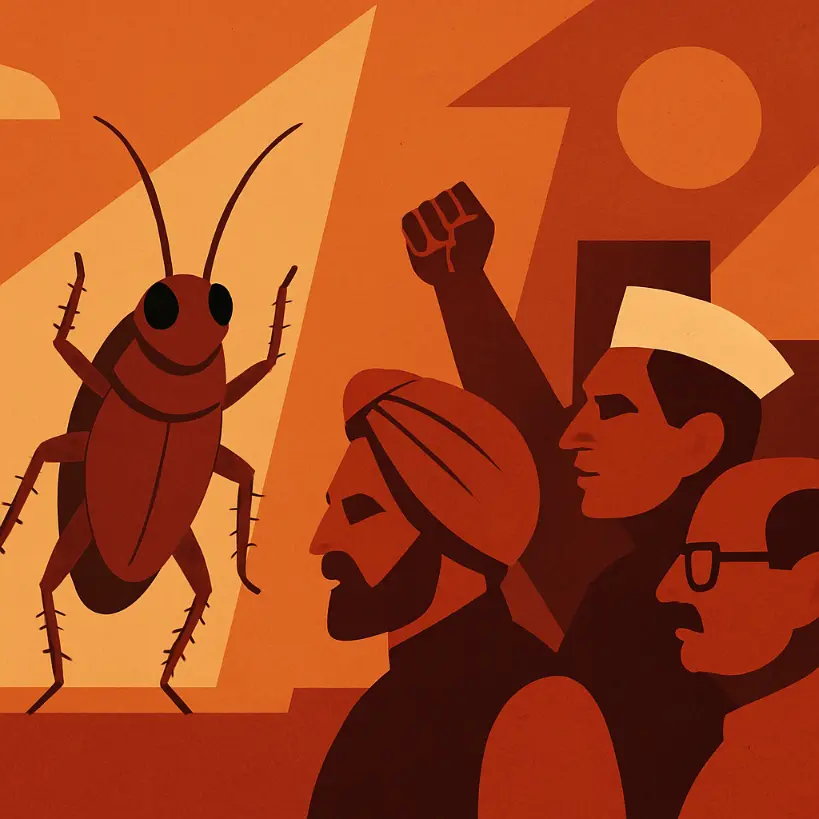
The movement was sparked by the comments allegedly made by Chief Justice of India Surya Kant on May 15 that unemployed youth and online critics were “cockroaches” and “parasites”. In a matter of hours, a digital community took the term back and changed its definition from insult to identity.
The users re-interpreted the meaning of the remark by placing the cockroach in a position that symbolizes survival and adaptability. It was a part of the movement’s identity, and, as in much of digital culture, negative labels were redefined as markers of resilience.
This inversion was further strengthened by the name of the “Cockroach Janta Party”. It reproduced the political party structures and at the same time ridiculed them, producing a brand that was in turn a parody and a commentary on political parties.
Digital identity shaped by irony and participation
CJP is ironic by its nature. Its non-codified principles of membership, which are sometimes presented as “unemployed, chronically online, and professionally opinionated”, reflect more closely the language of internet subcultures than conventional political groups.
Membership of the movement is not a formal requirement, but rather engagement with the content. Its decentralised design enabled it to grow rapidly, with the users using its language, sharing its symbols, and adding to its evolving story without hierarchical coordination.
Fundamentally, CJP is a reflection of a changing process of collective identity construction in online environments as humour and relatability have become more salient than ideology and organisation.
When satire overlaps with political messaging
The movement, though satirical, has spread a variety of organized political demands. These include calls for electoral reforms such as restrictions on political defection and limitations on post-retirement appointments in legislative positions.
In tandem with this, issues related to the movement have raised governance concerns, among them the need for more women to be represented in Parliament and more accountability in education systems. The combination of humour and a policy-critical approach creates a hybrid quality for the movement, in which satire serves as an expression and a framing device.
From online virality to offline visibility
The movement was not limited to online platforms. Reports of “offline” activity ranged from symbolic protests, public clean-up drives to demonstrations using cockroach costumes as a visual metaphor.
These happenings took the movement’s online presence into the real world. The use of traditional protest frameworks was not the focus, but instead, emphasis was given to visibility and symbolism in line with the way meme culture manifests in the physical world.
Regulatory response and legal proceedings
The movement began to grow quickly and is said to have received government attention. Authorities banned associated digital accounts, on the grounds of national security, and led to a broader discussion about the boundaries of online expression and platform management.
The case went to the Delhi High Court and interim relief was denied for the restoration of the movement’s X (formerly Twitter) account. The court referred petitioners to the IT Rules review mechanism, while fixing a further hearing date for July 2026. The case brought to the fore institutional issues in relation to decentralised and rapid-moving digital movements.
A reflection of changing political expression
It is not the satirical tagging of the party that makes the Cockroach Janta Party so important, but rather it provides a glimpse into today’s political participation. Political expression is no longer an organised activity, but is now taking the form of memes, irony and a common language for younger people.
This change is evident in the context of CJP. It offers insight into the way language is reimagined, identity is developed and political ideas echoed in an online community using forms that merge humor and critique. It is in this way that it embodies a wider shift in political voice in the digital public sphere.