





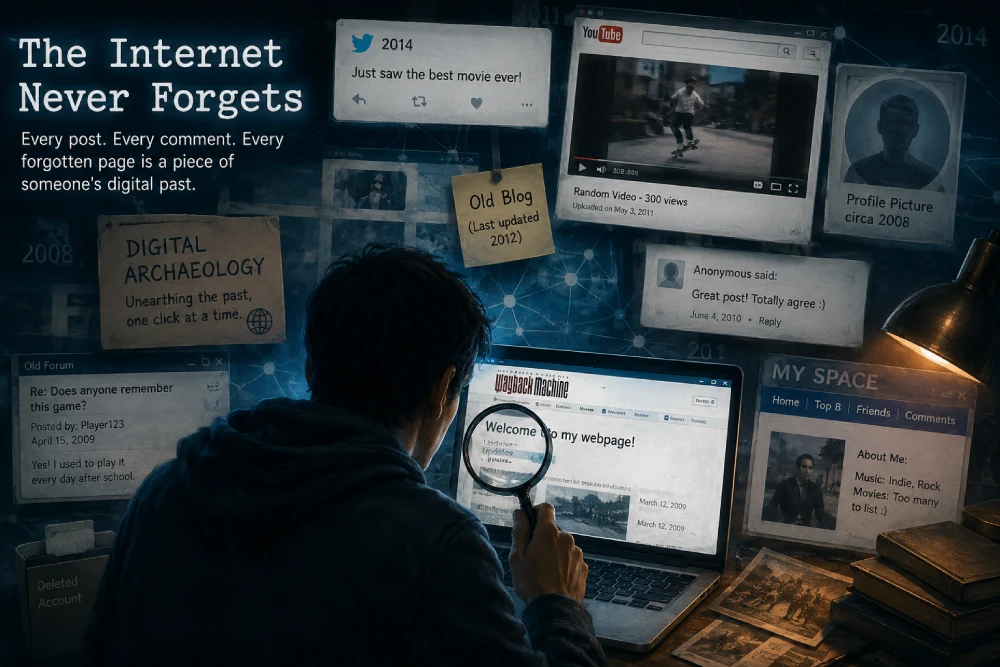
There is something strange about the internet that we rarely discuss. While it is obvious that many things are happening right now on this giant network, it holds a vast amount of information that refuse to die. An old tweet from 2014 A forgotten YouTube video with 300 views A dead blog written by someone who hasn’t posted in ten years A comment buried underneath a random article A profile picture from someone’s school days that they completely forgot existed The internet has slowly turned into a large museum of things people never intended to preserve. I call this accidental digital archaeology Digital archaeology is not really digging through ancient computers. It is about ordinary people discovering pieces of the internet’s past and trying to understand the people who created them. Surprisingly, social media is making this phenomenon bigger
The Internet Never Really Forgets
Before social media became part of everyday life, forgetting something was fairly easy. You could lose an old photograph. A diary could disappear in a cupboard. A letter could be thrown away. Online, things are much different. Something can be completely forgotten by its creator but still be available to thousands of strangers. This creates a strange situation: the person who created something might no longer remember it, but the internet does. Someone might suddenly find an old forum post written by a teenager who is now an adult. They might find an ancient video uploaded before the creator became famous. They might even stumble upon a website belonging to someone who hasn’t touched the internet in years. The fascinating part isn’t simply discovering old content It is realizing that every username was once a real person having a real day
Behind an old comment was somebody sitting somewhere, probably unaware that a stranger would read their words more than a decade later.
The Weird Comfort of Old Internet Modern internet culture seems extremely polished. People carefully choosing photographs. Creators planning captions. Brands manufacturing personalities. Even ordinary people sometimes think about how their posts will look months later. Old internet was different. It was messy. People were using strange usernames. They were uploading blurry photographs. They were writing overly long status updates. They were designing terrible personal websites. They were arguing with strangers over things nobody remembers anymore. And somehow, that messiness feels authentic.
When people discover old content today, they often laugh and feel embarrassed. But there is another emotion underneath.
Old internet reminds us that people were always awkward online. We didn’t suddenly become embarrassing because of TikTok, Instagram or Snapchat. Humans have been posting questionable stuff on the internet since the internet gave them somewhere to post them. The technology changed, the awkwardness didn’t.
Forgotten Digital Lives
One of the strangest things about internet culture is that people can leave behind entire digital versions of themselves. Imagine finding someone’s old profile from 2009. Their interests are different. Their friends are different Their writing style is different.
Maybe they were obsessed with a band they haven’t listened to in fifteen years. Maybe they wrote about wanting a career they never pursued. Maybe their biggest concern at the time was something that will eventually be completely insignificant. You’re looking at a time capsule, except the person who created the time capsule didn’t know they were making one That’s the thing that makes accidental digital archaeology different from traditional archives Museums preserving things by intention The internet by accident
The New Internet Detective
This has also created a new kind of online behavior. People have become surprisingly good at investigating digital history
A strange photograph can lead to an old username. That username can lead to a forgotten forum. The forum can lead to another website. Some people have already reconstructed a tiny piece of internet history that nobody was actively trying to preserve. Sometimes it is harmless curiosity People enjoy finding the origins of memes, forgotten websites, discontinued online communities or mysterious media. But there is also a very important boundary Finding history is not the same as invading someone’s present. An old public post may be interesting, but the person behind it still deserves privacy Digital antiquing becomes unhealthy when curiosity turns into obsession . Just the fact that something is technically accessible does not mean that it should be dragged back into someone’s life.
Why Gen Z and Gen Alpha Are Becoming Internet Historians
Younger internet users have grown up inside an unusual contradiction. They have access to more digital history than any previous group, while the thing itself changes incredibly quickly.
A platform can become popular, disappear, return in a different form, and disappear again. Features that once seemed permanent can vanish overnight. This has resulted in a growing interest in “old internet” People are discovering forgotten aesthetics, early social media, old memes, strange websites and abandoned online communities It’s almost like discovering a civilization that existed a few years ago The funny part is that some of this “history” isn’t even that old A teen can describe something from 2016 as ancient internet culture. For someone who still remembers using the internet in 2016, that can feel slightly offensive. But it reveals something important: internet time is different from regular time. Ten years on the internet can feel like several technological eras. Maybe the Internet Is Becoming Our Collective Memory There is a greater question buried underneath all of this.
What will happen when humans stop being the main memory keepers over their own memories?
Our grandparents kept photographs. Our parents kept albums, letters and home videos. We keep cloud storage, social media archives, screenshots and forgotten accounts. The difference is scale . One person’s digital history can contain thousands of photographs, hundreds of conversations and years of thoughts.
Much of it may survive long after the person has stopped thinking about it. That’s both fascinating and slightly unsettlingThe internet isn’t merely recording history anymore; it is also recording ordinary people’s history Not just presidents, celebrities and famous events, but random Tuesday afternoons, stupid jokes, teenage arguments, first profile pictures and two a.m. thoughts. Human history used to be dominated the things people considered important enough to preserve The internet is changing that. It is preserving things because no one bothered to delete them.
The Future Will Be Full of Digital Ghosts
Years from now, people will likely look back on today’s internet the same way we currently do old photographs. They will discover memes that we have long forgotten ,Arguments that nobody remembers Trends that make no sense outside their original context Accounts belonging to people who have completely changed. They might wonder why we behaved the way we did. They’ll laugh at our slang. They may be confused by our obsession over short videos. And maybe someone will find an ordinary post that I wrote today and wonder about the person behind it. That’s the strangest thing about digital culture. We spend most of our time thinking about what the internet will show us right now. But underneath the endless feed is something much larger: a constantly growing archive of human existence Maybe that’s the real future of internet culture. Not faster trends, nor more viral content. But a world where almost everything we casually put online becomes part of a history we never planned to write The internet was built to connect people. Nobody really ever expected it to become one of the biggest memory machines that humanity has ever created.
Conclusion
Perhaps the most interesting thing about internet culture is that we rarely realize when we’re creating history. We post, comment, share, delete and move on, assuming those moments will eventually disappear. But somewhere, something will always remain. Years from now, the internet may not only tell the story of major events. It may tell the story of ordinary people-their jokes, interests, friendships, opinions and little moments that once seemed completely unimportant. That makes the internet more than a communications tool. It is becoming a massive, imperfect memory of everyday human life
And maybe next time we discover an ancient post and laugh at how strange the internet used to be, we should realize one thing: someone in the future might be looking at our internet the exact same way