




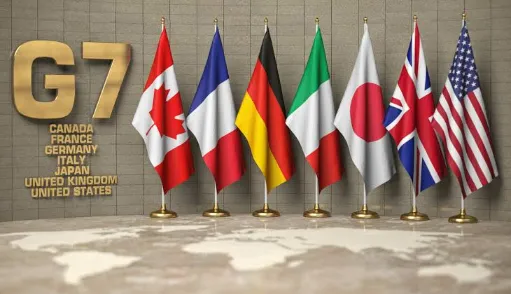
The 52nd G7 Summit was held this year from June 15-17 in the lakeside resort town of Evian-les-Bains, France, making it the first French town to host the leaders’ summit twice, having previously hosted it in 2003.
The core participants included the standard G7 member states: France, the United States, the United Kingdom, Germany,Japan, Italy, and Canada – alongside representatives from the European Union. To prevent the summit from feeling like an exclusive club, France invited a powerful lineup of outreach countries to participate in the discussions, including India, Brazil, Egypt, Kenya, South Korea, Qatar, Ukraine, and the UAE.
The summit kicked off under the shadow of heavy geopolitical tension, but the mood shifted positively just before the opening sessions following a major diplomatic breakthrough: an understanding between the USA and Iran aimed at stabilizing West Asia and ensuring that the crucial Strait of Hormuz remained open to international shipping.
With that momentum, the leaders sat down to tackle a packed agenda centered on industrial overcapacity, building more resilient supply chains for critical microchip minerals, and creating stricter digital safety rules at the forum. Global healthcare was pushed to the absolute forefront,resulting in major data-sharing pacts to fight cancer and a joint funding injection of over $1 billion to manage the critical Ebola outbreak in Africa.
When it came to international development,the entire tone of the summit shifted as India and other guest nations stepped into the room to aggressively represent the interests of the Global South. Prime Minister Narendra Modi did not mince words,explicitly calling out the “global trust deficit” and stating that a lack of respect for international law is currently the single biggest hurdle to real global solidarity. India directly challenged the old-school international aid systems,telling the wealthier G7 nations that it is time to permanently dump the outdated “donor-recipient” mindset. Rather,India pushed for an equitable partnership based on mutual respect,technology transfers,and the rollout of open-source Digital Public Infrastructure, like its UPI payment system, to help developing countries build their own financial systems without getting trapped in cycles of debt.
While India took a tough stance on trade restrictions,it actively collaborated where it mattered,ultimately choosing to sign on to the G7’S major global health declaration regarding cancer and Ebola.
On the sidelines,the summit also served as a massive networking hub where India quietly secured its own strategic interests. PM Modi held extensive bilateral talks with Canada’s Prime Minister Mark Carney to fast-track their Comprehensive Economic Partnership Agreement with a goal to finish by the end of this year,while also advancing a massive multi-billion dollar nuclear energy deal and a defense intelligence sharing pact. Similar,fast-track discussions were held with the UK under the Vision 2035 framework and with the UAE to secure maritime shipping corridors,proving that even without official membership,the G7 nations heavily rely on India to anchor economic stability and secure across the Indo-Pacific.