



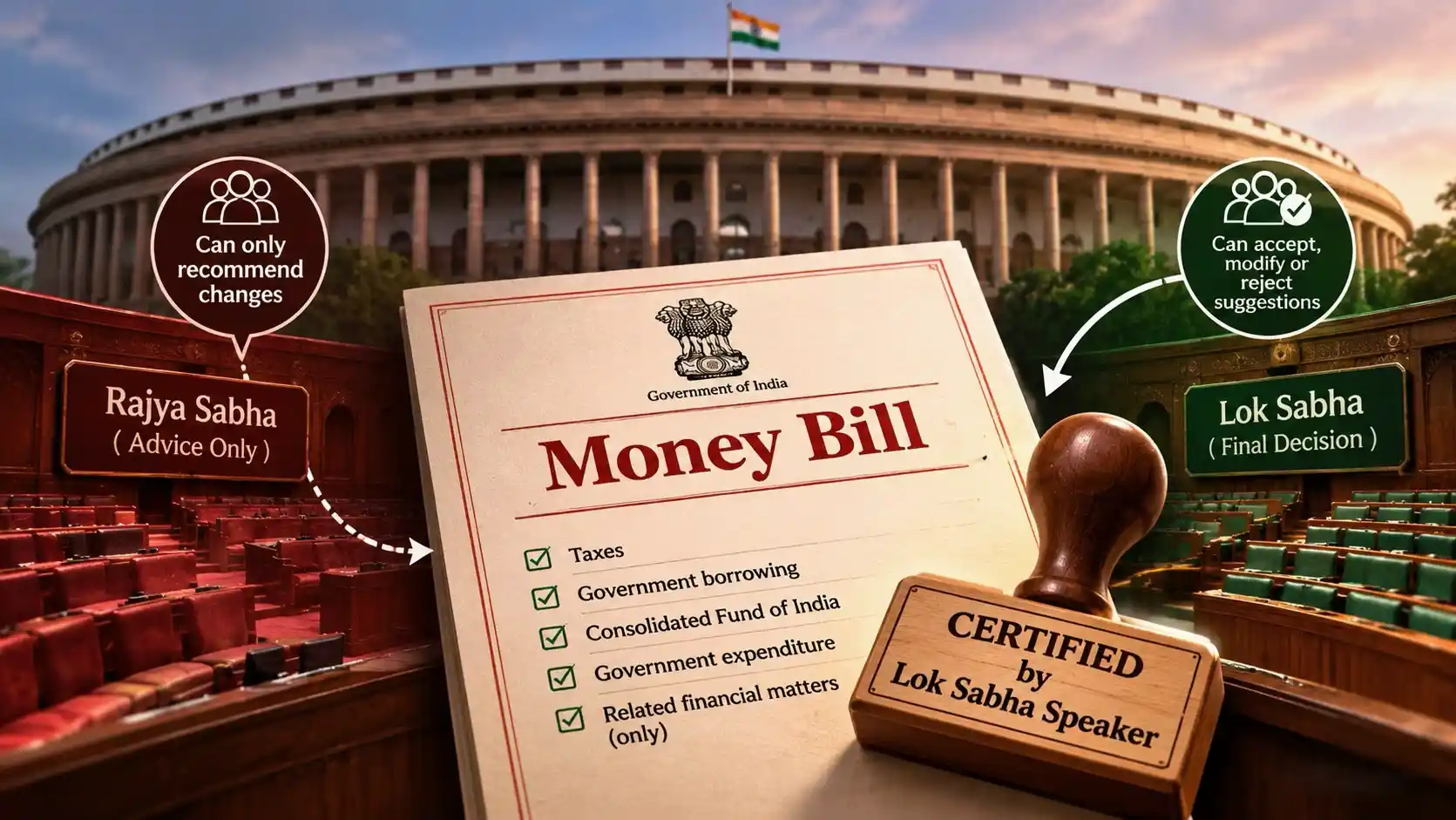

A Money Bill needs the Upper House only for advice, and the person who decides whether a bill qualifies is the Lok Sabha Speaker
Most laws in India must clear both Houses of Parliament. A small category of bills does not. Once a bill is classed as a Money Bill, the Upper House loses its power to say no and can only offer advice that the Lok Sabha is free to set aside. That one label has shaped budgets, taxes and a few of the most contested laws of recent years, so it is worth knowing how it works.
A Label With Consequences
The definition sits in Article 110 of the Constitution. A bill counts as a Money Bill only if it deals solely with matters listed there: imposing or changing taxes, government borrowing, the handling of the Consolidated Fund of India, and spending charged to it, along with anything strictly incidental to those. If a bill contains even one provision outside that list, it should not qualify.
Only One House Gets to Start It
Every Money Bill begins its life in the Lok Sabha. The Rajya Sabha cannot originate one, and the government cannot table one at all without first securing the President’s recommendation. After the Lower House votes it through, the bill travels to the Rajya Sabha in a purely advisory capacity. Members there can debate it and propose amendments, but they can neither reject it nor change a word of it on their own. Whatever they suggest goes back to the Lok Sabha, which is free to accept all of it, some of it, or none of it.
The Fourteen-Day Clock
The Upper House also works against a deadline. It gets 14 days from the date a Money Bill reaches it to return the bill along with whatever amendments it proposes. If that period runs out with no response, the Constitution treats Parliament as having approved the bill exactly as the Lok Sabha passed it. Ordinary bills that stall between the two Houses can be settled at a joint sitting, but that mechanism is unavailable here, and it is not needed: because the Rajya Sabha can only advise, there is never a real disagreement to settle. On money matters, the final call rests with the Lok Sabha.
Who Holds the Stamp
Everything turns on a single certificate. Before forwarding the bill to the Upper House, the Speaker of the Lok Sabha signs off on it as a Money Bill, and the Constitution declares that verdict final. The Speaker therefore controls access to the entire route, and Speakers usually come from the governing party. Trouble starts when a bill that reaches well past taxation and spending receives the certificate regardless.
The Aadhaar Test
The sharpest dispute so far came in 2016. The ruling coalition was short of numbers in the Upper House when it routed the Aadhaar Act through as a Money Bill, and the changes the Rajya Sabha proposed were turned down by the Lok Sabha. The law was challenged, and in 2018 a five-judge Constitution Bench of the Supreme Court upheld the certification by a 4 to 1 vote; the lone dissent argued that the Act should never have been classified as a Money Bill.
The issue resurfaced a year later in a case over tribunal provisions tucked into the Finance Act, 2017, where the Court referred the wider question of whether courts can review a Speaker’s certification to a larger bench.
Why Governments Like the Route
The attraction is simple. A Money Bill avoids the delays and defeats an Upper House can cause when the ruling alliance is short of seats there. For budgets and tax changes, that speed is the purpose of the rule, because a government must be able to collect and spend money without being blocked by the House it does not directly answer to. The worry begins when the route is used for measures that go well beyond finance.
The Argument From the Other Side
Those who object say the Rajya Sabha was designed to be a check on the Lok Sabha, and stretching the definition quietly removes that check. Defenders of the practice reply that the Constitution gave the Speaker the power on purpose, and that elected Lok Sabha members have the stronger claim to decide on money. Both sides are making a claim about what the Constitution’s authors intended.
How to Read the Next Budget Debate
Before judging the next Budget debate, run three checks. First, does the bill stay within taxation, borrowing and expenditure? Second, does it carry the Speaker’s Money Bill certificate? Third, has it been sent on to the Rajya Sabha, starting the 14-day clock? Together, the answers show whether the Upper House holds a vote or merely a voice.