





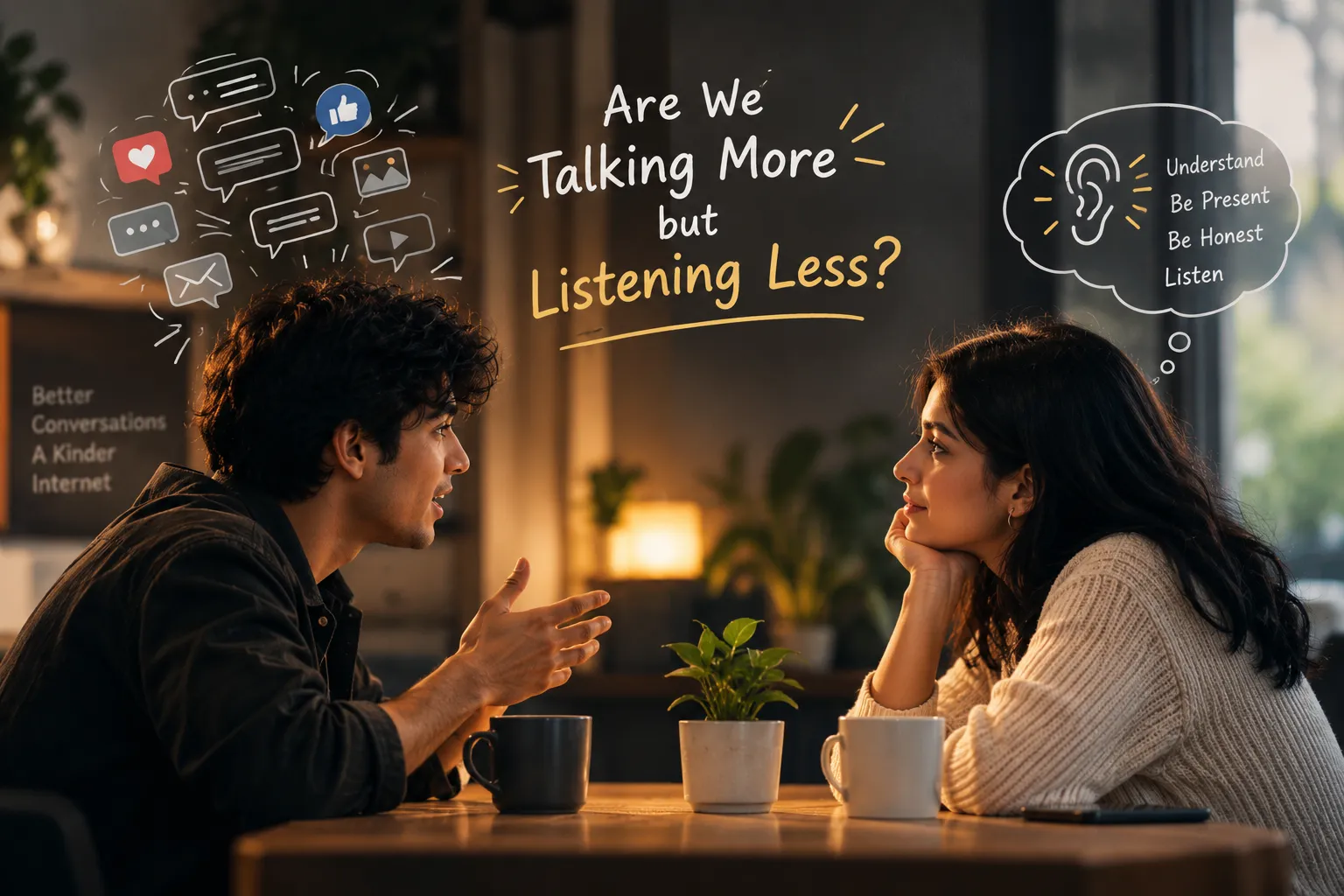
We live in a world where silence has almost become uncomfortable. From morning until night, people exchange messages, upload stories, comment on posts, participate in group discussions, and share their opinions on almost everything. Conversations have become easier to start and faster to continue. Yet, somewhere between all these words, an important question arises: are we actually listening to one another, or are we simply waiting for our turn to speak?
Communication has never been as convenient as it is today. A person sitting thousands of kilometres away can become part of our daily life through a simple video call. Friends can stay connected through messages, and strangers can discuss their experiences on online platforms. Despite these advantages, meaningful communication seems to be facing a quiet challenge. We have more opportunities to express ourselves, but fewer moments in which we genuinely try to understand someone else.
The Habit of Preparing a Reply
Think about the last time someone shared a personal problem with you. While they were speaking, were you completely focused on their words, or were you already thinking about what to say next?
This small habit reveals something important about modern conversations. Many people listen with the intention of responding rather than understanding. Instead of paying attention to the speaker’s feelings, they begin preparing advice, comparing the experience with their own lives, or searching for a suitable reply.
Sometimes, we interrupt because we are excited to share a similar story. At other times, we believe we already know what the other person is going to say. Whatever the reason, the conversation gradually becomes a competition between voices rather than an exchange of thoughts.
Listening requires patience. It asks us to remain present even when we disagree, feel uncomfortable, or have something interesting to contribute. In a world that encourages quick reactions, patience can feel surprisingly difficult.
Social Media and the Need to Be Heard
Social media has given ordinary people a powerful platform to express opinions that might once have remained unheard. People can discuss social issues, share personal experiences, challenge unfair practices, and connect with communities that understand them. This freedom is valuable and should not be underestimated.
However, the culture of constant posting also encourages us to respond immediately. A controversial statement appears, and within minutes, thousands of reactions follow. People often read a headline, form an opinion, and join an argument before understanding the complete situation.
Online discussions can quickly become focused on proving someone wrong rather than discovering what might be right. The number of likes, comments, and shares can sometimes become more important than the quality of the conversation.
Another problem is that written communication does not always carry the emotions behind our words. A short reply may appear rude when the sender is simply busy. A joke may be misunderstood, and a serious concern may be dismissed because it does not fit the mood of the discussion.
Technology is not necessarily making us worse listeners. Rather, the speed and structure of digital communication can make thoughtful listening harder when we do not use these tools carefully.
When Listening Becomes an Act of Care
Listening is often mistaken for doing nothing. We may assume that helping someone means offering advice, solving their problem, or telling them how to move forward. But sometimes, people do not need solutions. They simply need a space where they can speak without being judged.
Imagine a student who has had a difficult day. When they share their worries with a friend, they may not be asking for a lecture about time management or a list of ways to improve their performance. They might only want someone to acknowledge that their experience has been exhausting.
A simple question such as, “Do you want advice, or would you rather talk about it?” can change the entire conversation.
Genuine listening does not mean agreeing with everything another person says. It means respecting their right to explain their perspective before we evaluate it. We can disagree without insulting, question an opinion without attacking its author, and acknowledge someone’s feelings without pretending to share the same experience.
In this sense, listening is not weakness. It is a form of emotional maturity.
The Silence We Need to Rediscover
Modern life rarely leaves us alone with our thoughts. Even during a short break, we often reach for our phones. Waiting in a queue becomes an opportunity to scroll, travelling becomes a time to watch videos, and quiet moments are quickly filled with background noise.
Constant stimulation can make silence feel like wasted time. Yet, silence has an important role in communication. It gives people room to think, process emotions, and choose their words carefully.
A pause does not always mean that a conversation has failed. Sometimes, it means someone is trying to express something difficult. Rushing to fill every silence may prevent them from finding the words they need.
We do not have to abandon technology or avoid conversations to become better listeners. Small changes can make a difference: putting the phone aside during an important discussion, allowing someone to finish speaking, asking questions instead of making assumptions, and remembering details they shared earlier.
These actions may seem ordinary, but they communicate something powerful: your words matter to me.
Learning to Hear Beyond Words
Perhaps the real problem is not that people have too much to say. It is that we sometimes forget communication involves two equally important responsibilities: expressing ourselves and making room for others.
Every person carries experiences that cannot be understood through a photograph, a social media profile, or a few sentences. Behind a confident opinion may be uncertainty. Behind an angry response may be disappointment. Behind a cheerful smile may be a difficult day that nobody knows about.
We cannot understand every person completely, but we can make an honest effort to understand them better.
The next time we enter a conversation, we can try listening without planning our reply. We can ask one more question before reaching a conclusion. We can resist the urge to turn every discussion into a debate and allow someone else’s experience to exist without immediately comparing it with our own.
The world does not necessarily need fewer conversations. It needs conversations in which people feel safe enough to speak and respected enough to be heard.
We have become remarkably skilled at making our voices travel across the world. The next challenge is learning how to give those voices our attention.
Because, in the end, communication is not measured by how many words we exchange, but by how much understanding remains after the words have been spoken.