




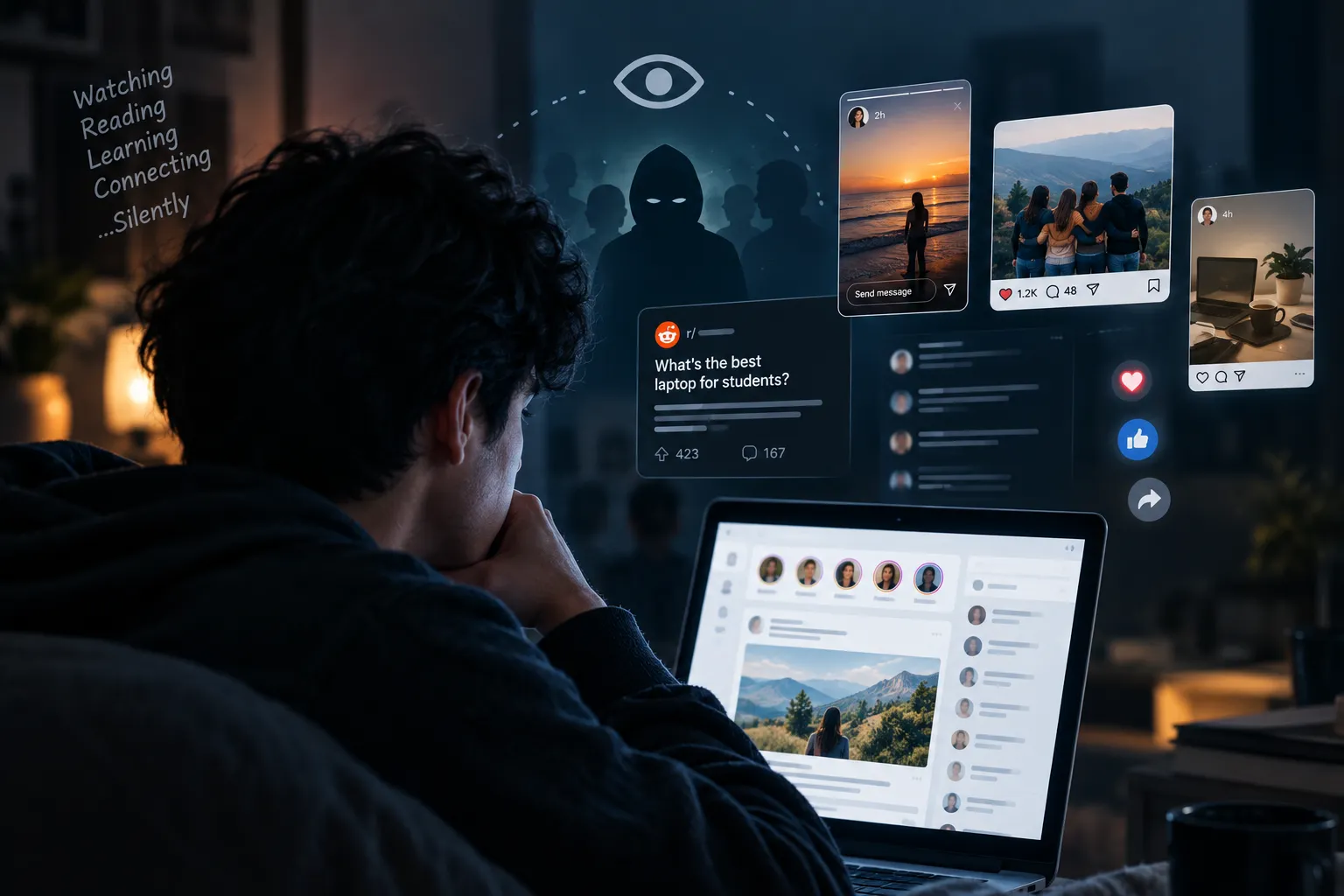
Every day, millions of people open social media, scroll through posts, read comments, watch stories, and quietly leave without liking or sharing anything. They know what their friends are doing, follow strangers’ conversations, and sometimes understand an online community better than its most active members. Yet, their names rarely appear in discussions. These people are known as online lurkers.
Online lurking is the habit of observing digital spaces without actively participating in them. Although it may look like an unimportant part of internet culture, it reveals something interesting about the way people communicate, protect their privacy, and connect with others in the digital age.
The People Who Watch Without Speaking
Social media often makes participation look like a public performance. Likes, comments, reposts, and followers become visible signs of engagement. However, not everyone wants to make their presence known. Some people prefer to read discussions on Reddit, watch Instagram stories, explore online communities, or follow trending conversations without leaving any reaction.
Imagine joining a college group online before attending your first class. You might read every message, understand everyone’s sense of humour, and learn about upcoming events without introducing yourself. You are technically part of the group, even if nobody notices you.
This is one of the simplest examples of lurking. People observe first because they want to understand the environment before deciding whether they belong in it.
Why Do People Choose Silence?
The reasons behind online lurking are more complicated than simple shyness. For some, silence is a matter of privacy. They may enjoy learning about other people’s experiences but feel uncomfortable sharing details about their own lives. Others worry that a harmless comment could be misunderstood, criticised, or taken out of context.
There is also the pressure to appear interesting online. A photograph, opinion, or personal story can remain visible long after the moment has passed. When people realise that their posts may be judged by classmates, colleagues, relatives, or strangers, staying silent can feel easier than expressing themselves publicly.
Sometimes, people are simply tired. Constant notifications and endless conversations can make social media exhausting. Reading without responding allows them to remain informed without accepting the responsibility of participating in every discussion.
For many users, then, lurking is not a sign of disinterest. It is a personal way of managing attention, comfort, and boundaries.
The Difference Between Being Invisible and Being Disconnected
One fascinating aspect of lurking is that people can feel connected without speaking. A person struggling with a difficult situation might read stories from others who have experienced something similar. Even without commenting, they may feel less alone.
Similarly, someone interested in photography, cinema, technology, or literature can learn from online communities without publishing their own work. By observing how people exchange ideas, disagree, and solve problems, silent readers gradually develop their understanding.
In this sense, lurking can be a form of learning. It allows people to listen before speaking and think before responding.
However, there is a difference between quietly enjoying online content and constantly watching other people’s lives while feeling unhappy about one’s own. When observation becomes endless comparison, social media can create unnecessary pressure. Watching everyone else’s achievements without remembering that online posts show only selected moments can distort our understanding of reality.
How Lurkers Influence Internet Culture
Although lurkers rarely create visible activity, they are not necessarily unimportant. Research on online communities has found that silent users can make up a substantial part of their audiences. Their attention also matters because platforms use different signals of user activity to organise and recommend content.
Consider a viral post with thousands of views but relatively few comments. Many people may have read it, agreed with it, learned from it, or privately shared it with a friend without responding publicly. The visible conversation represents only part of the audience’s experience.
Lurkers also influence internet culture through what they choose to watch repeatedly. Trends, jokes, opinions, and styles can spread as people encounter them across different platforms. Not every person who contributes to a trend needs to create a post about it.
This makes online participation more complicated than counting likes or comments. Sometimes, the quietest audience is larger than the visible crowd.
The Hidden Cost of Watching Everything
Despite its advantages, lurking has another side. Constantly observing others can create a strange sense of familiarity. People may begin to feel that they know a creator personally simply because they have watched hundreds of videos about that person’s life.
This one-sided familiarity can blur the boundary between public content and private relationships. It can also encourage assumptions about people whose experiences are only partially visible online.
Another concern is privacy. Browsing silently does not necessarily mean leaving no digital trace. Platforms may collect information about viewing behaviour, searches, and interactions, depending on their features and privacy settings. A person may remain invisible to other users while still generating data for the platform.
Understanding this difference is important. Being quiet online does not automatically mean being anonymous.
Giving Silence Its Own Place
The internet has created an environment where people are often encouraged to express opinions, build personal brands, and make their lives visible. In such an environment, online lurkers remind us that communication does not always require an announcement.
People should be able to explore communities, learn from discussions, and protect their privacy without feeling obligated to post. At the same time, they should recognise when silent observation is helping them understand the world and when it is simply keeping them trapped in endless scrolling.
The hidden culture of online lurking tells us that digital life is not shaped only by those who speak the loudest. It is also shaped by people who listen, notice, reflect, and choose their moments carefully.
Perhaps the most interesting question is not why so many people remain silent online, but why we have come to believe that silence means an absence of participation. In a world where everyone seems eager to be seen, choosing to observe can be meaningful in its own way.
After all, not every presence needs to leave a comment to be real.