




The pattern on every shop counter is a tiny filing system with its own repair kit, and the same design is what scammers lean on
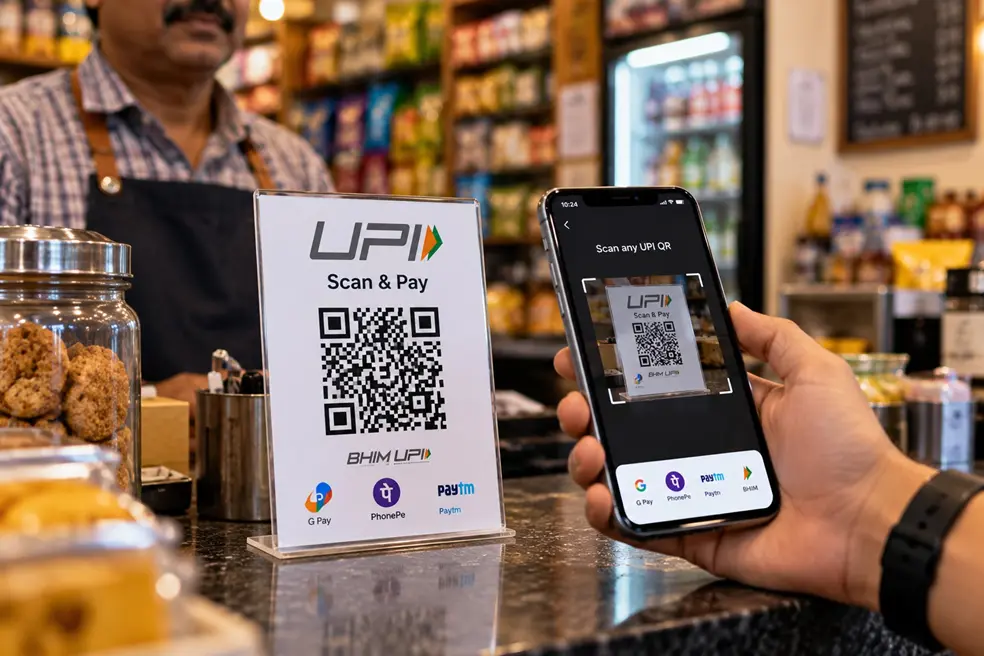
At tea stalls, petrol pumps, restaurant tables and bus stops, a square of black and white dots has become part of everyday Indian life. People scan it without a thought. Yet that square is an engineered object, and several of its features explain both why it is so dependable and how it gets misused.
A Fix for a Factory Problem
In 1994, a team at Denso Wave, a Toyota group supplier, produced the first QR code under engineer Masahiro Hara. The name abbreviates Quick Response. Car makers at the time labelled parts with ordinary striped barcodes, which carry only a short string and must be lined up carefully with the reader. The team wanted something that held far more information and could be picked up fast from any angle, so parts moving along an assembly line could be logged without slowing it down.
Orientation Without a Guide
Look at three corners of any code: top left, top right and bottom left. Each carries a large nested square, and scanners treat those three as landmarks. Because the fourth corner is left without one, the software can tell at once how the code is rotated, even if the phone is held sideways. From the second size upward, a smaller marker also sits toward the lower right. It lets the reader straighten out distortion when a code is stuck on a bottle or snapped from a slant.
Repair Data Hidden in the Pattern
Mixed in with the data squares is extra information produced by a maths technique called Reed-Solomon coding. It gives the scanner enough redundancy to rebuild whatever is unreadable. Code makers pick one of four protection levels, from light to heavy. At the heaviest, around 30 percent of the symbol can be lost and the message still comes through. That is how a printed logo can sit over the centre of a code, and why a worn or sun-bleached sticker often reads without trouble.
How Big Can It Get?
There are 40 standard sizes, numbered one to forty. A simple rule links the number to the width: multiply the version number by four and add 17 to get the count of tiny squares along one side. That makes version 1 a 21 by 21 grid and version 40 a 177 by 177 grid. The larger the grid, the more it can hold. Under the lightest protection setting, version 40 can store over 7,000 digits, or around 4,000 characters if letters and numbers are mixed. Real-world codes are mostly modest, since a web link or a payment address takes very little room.
Fixed Codes and Fresh Codes
A lot of Indian shopkeepers put up a single permanent code that contains nothing but their UPI address, and customers type in the figure themselves. Restaurant bills and online checkouts work differently. They generate a new code every time, already loaded with the price and a reference for that particular order.
Either way, the square only delivers a piece of text. What counts is what that text asks your phone to do next.
Where Fraud Slips In
Fraudsters rely on a simple confusion. They send you a code, say that scanning it will put money in your account, and then ask you to type your UPI PIN. But a PIN does one job only, which is to approve money going out. Receiving a payment needs neither a PIN nor a scan. If someone insists on a PIN before you can be paid, you are being set up to lose money. Another trick is to stick a counterfeit code over a shop’s genuine one, which sends customers’ payments to a stranger. The name displayed on your screen before you confirm is your protection, so compare it with the shop in front of you.
What a QR Code Cannot Promise
A QR code carries data, but it does not vouch for it. The same grid can lead to a bank page or a fake one. Most phone cameras now show the link before opening it, so read the address first and proceed only if it looks right.