





Introduction
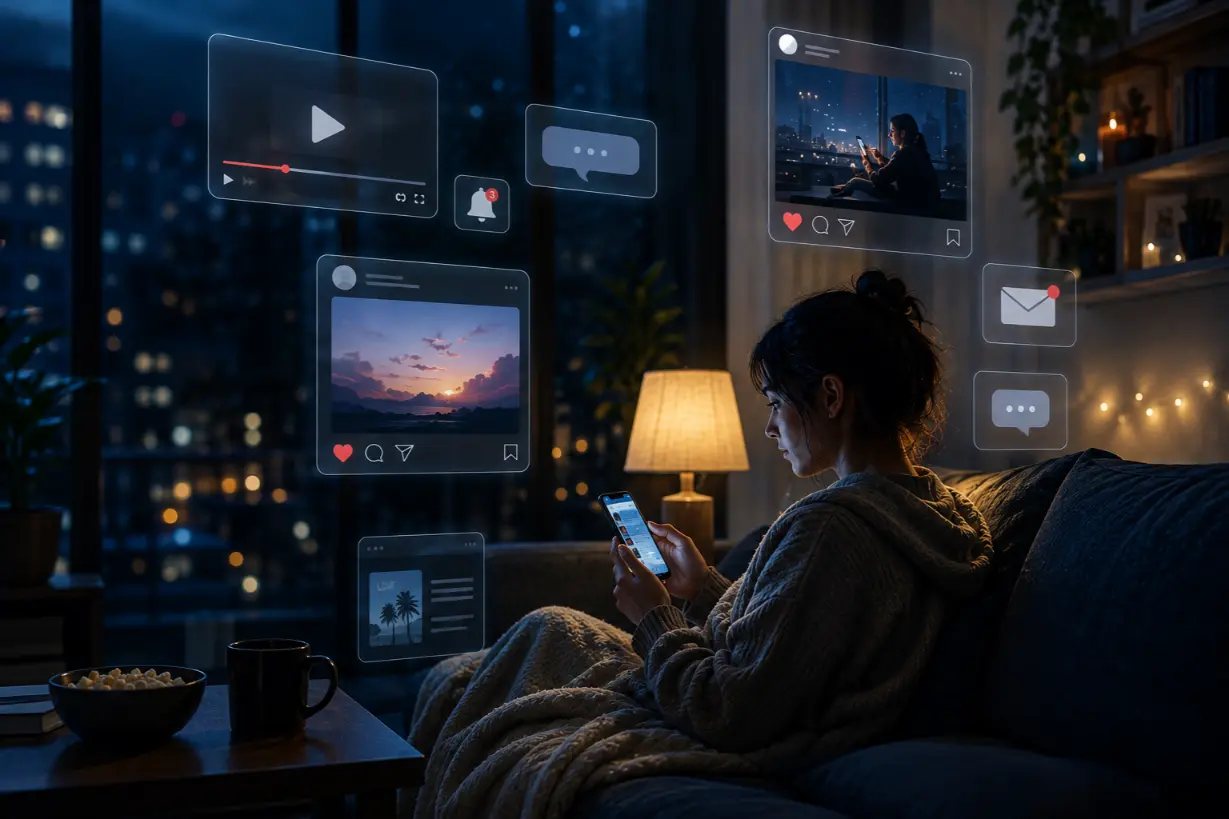
There was a time when going on the internet meant that you were doing something. We opened up the internet to find information, to send emails, to watch a video, to chat with someone. Today, however, many of us spend time online without really having a reason to be there in the first place. We open Instagram, scroll. We refresh a page knowing that nothing new has appeared on it. We check the messages, close the app, open it again in a few minutes. Sometimes we are not even entertained, simply not wanting to be away from the screen. This strange phenomenon can be termed the ‘invisible waiting room’ of the internet – a space where millions of us spend our time waiting for something interesting to happen, but without knowing what we are waiting for. It is not simply social media addiction, or boredom. It is the creation of a new kind of internet culture – one which revolves around presence without participation.
When Being Online Became a Habit
The early internet rarely had a clear objective. We went on the internet because we wanted to do something. We would search for a website, join a chat room, download something, check our emails. Modern internet culture, on the other hand, has created an environment in which the internet follows us throughout the day. There is rarely a distinct beginning or ending to our online time, with the possibility of us checking our phones always present. We may be waiting for a class, in a car, at home – and the thought that something new may have appeared on the screen is enough for us to refresh. The internet has shifted from a destination to a background presence.
The Culture of Refreshing
One of the most fascinating parts of the modern internet is how constantly we refresh. While a technical process is simple, culturally it holds a great significance. Every time we refresh, there is a small hope within us – maybe something had happened since the last time. Maybe someone has responded to us Maybe a friend had posted something Maybe there is breaking news Maybe someone had uploaded something our favorite person had created. Sometimes there is nothing particularly interesting. Nonetheless, we refresh once more, our relationship with the internet being one of constant searching. We are not always searching for information, but for the possibility of something happening.
Why Silence Feels Uncomfortable
Another aspect which is notable in the culture of the internet is our general discomfort with silence. Imagine sitting in a room with no phone, no music, no video, no chat – for many of us, such a scenario can be an uncomfortable one. The internet has taken over many of our dead hours with its presence – and, perhaps, has created situations where we have grown to dislike being bored. A two-minute wait is a perfect opportunity to watch a few reels, a two-minute walk can give us the time to check our phones. A queue gives us the perfect excuse to check our notifications. As a result, boredom has begun to be seen by us as an immediate threat which must be dealt with right away. This is not to say that it is disappearing, but that we are growing more unfamiliar with it.
The Internet as Emotional Background Noise
The internet has also become a kind of emotional background noise for many of us. While we may be alone, we watch funny videos. While we study, we play podcasts. While we think about something we do not want to consider, we scroll through the Instagram feed. It is not that the particular content interests us – rather, it is the fact that something is happening on the screen, no matter what it is. Internet culture is quite different to traditional entertainment in this respect – the television usually asks for our full attention, while modern platforms can accompany us almost anywhere. The internet does not always entertain us – sometimes, it simply keeps us company.
The Fear of Missing Something
One significant reason why we spend time online is the dread of missing out. A conversation could continue, a meme could go viral, a friend could upload something, a piece of news could spread. There is a strange mental loop we get into – nothing is really happening, but it could, at any moment, change. Therefore, leaving the internet can feel like abandoning a roomful of people who are trying to get our attention. This is why the culture of the modern internet has produced such an odd pressure. While nobody is explicitly asking us to stay online, the entire system and culture is designed such that we constantly have the possibility (and, in many cases, pressure) to not miss something important.
When Everyone Is Connected but Nobody Is Talking
The most surprising aspect of being on the internet is that it does not always mean being connected. Perhaps the most ironic part of the modern experience is that we can spend hours looking into the lives of others, without meaningfully speaking to a single person. We watch people’s birthdays, holidays, achievements, arguments, relationships, opinions, jokes, and tragedies unfold before our eyes – knowing only fragments of thousands of people’s lives. We can have a hard time speaking to the people next to us, while simultaneously following hundreds of other people’s posts. The internet has been very successful in helping us to connect, but meaningful connection remains elusive. That paradox may well be what defines internet culture.
A New Definition of “Doing Nothing”
Doing nothing, in the past, often involved sitting somewhere and simply being there. Today, it often means scrolling. Looking at what seems like a lot of activity on the internet, but not really consuming anything – perhaps, it was the next post which interested us, but not the one before it. In many ways, this can be seen as the modern internet culture having created a new ‘doing nothing’ – where we are actively engaging with the screen while being mentally absent.
Can We Leave the Waiting Room?
The solution to the problem is not necessarily to stop being online. The internet occupies a large part in our education, communication, entertainment and creativity, and there is no particular reason why it should stop. The problem arises when being online becomes our default, without us consciously engaging. Perhaps a better question is not ‘how many hours do I spend being on the internet’ but ‘what was the reason I came online this time?’ Sometimes there will be a specific activity. Sometimes the answer will be, ‘well – I was bored.’ These are both healthy answers, and a realization of the differences is essential to the situation.
Conclusion
The internet has progressed from something we went to, into something which surrounds us. We refresh, check, watch, read, move – without really being looking for something specific. We wait quietly within the invisible waiting room of the internet, expecting something new to happen. Perhaps this is one of the most overlooked parts of our modern culture – the internet is not only about information and communication anymore, but is about waiting, escaping, observing and filling the emptiness of the day. And, perhaps, the most crucial question of the future is – not whether the internet will become more entertaining to us, but if we will finally learn to appreciate the times when nothing happens at all.