





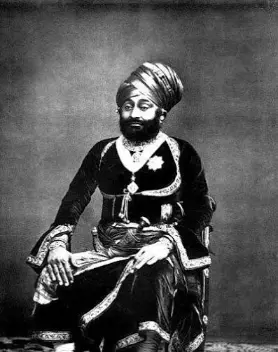
The Forgotten Hero of Narsingarh
When people discuss India’s fight against British rule, names like Rani Lakshmibai, Mangal Pandey, and Tatya Tope often come to mind. However, history is filled with forgotten heroes whose bravery and sacrifice deserve just as much recognition. One such warrior was kuwar Chain Singh of Narsingarh, a fearless prince who opposed British control decades before the famous Revolt of 1857.
According to local traditions and historical records from Madhya Pradesh, kuwar Chain Singh began his fight against the British in 1824, nearly 33 years before the First War of Indian Independence. His tale is one of remarkable bravery, patriotism, and an unyielding commitment to freedom.
Early Life of kuwar Chain Singh
Kuwar Chain Singh was born around the start of the nineteenth century in the princely state of Narsinghgarh, which is now part of Madhya Pradesh. He was known from a young age for his bravery, leadership, and excellent warfare skills.
He had a close bond with his loyal horse, Suryakiran, and his faithful dog, Sheru. These companions stayed with him throughout his life and became symbols of his fearless spirit.
The Growing British Influence
In the early 1800s, the British East India Company was quickly expanding its power across India. Many local rulers accepted British authority through treaties or political pressure. The rulers of Bhopal also decided to work with the British administration.
Kuwar Chain Singh strongly opposed this loss of independence. He felt that foreign powers had no right to control Indian lands and that freedom was worth fighting for, no matter the cost.
His resistance quickly led him to confront British officials, especially a British officer named Meddock .
Meddock’s Three Conditions
In order to curb the rebellion without resorting to warfare, Meddock imposed on Kunwar Chain Singh three conditions:
- He had to leave the state of Narsinghgarh forever.
- Narsinghgarh will be kept under British control for a period of three years.
- Only the British had the liberty to buy opium in Narsinghgarh.
These conditions were devised in order to undermine the sovereignty of the state in favor of the British domination over the area.
But Kunwar Chain Singh rejected all the three conditions with a resolute mind. He said that he would prefer fighting instead of letting the honor of his native land be humiliated.
Historic Meeting Held on 24 June 1824
Following unsuccessful talks, the situation had deteriorated between Kunwar Chain Singh and the British authorities.
Another meeting was planned for 24 June 1824 at Meddock’s military camp in Sehore. Thinking that the British would launch an attack, Kuwar Chain Singh went accompanied by around 50 faithful soldiers.
A famous swordsman, Kuwar came armed with two swords. Meddock apparently questioned him as to why he possessed two swords.
Responding in a very courageous and remarkable way, Kuwar Chain Singh replied:
“One sword will be used for decapitating the heads of the British, and the other will be used for Indians supporting them.”
The Battle Commences
Meddock requested to inspect one of the swords of Kunwar. But, Kunwar was able to sense that some sort of trap had been planned by Meddock. The moment Meddock tried attacking him, Kunwar retaliated immediately and there was an outbreak of an intense battle.
It soon turned into a huge war. As per common narratives, Kunwar Chain Singh along with his small army of around 50 men faced more than 10,000 troops from the British side.
Despite all those odds, Kunwar and his soldiers fought like brave warriors who showed no sign of being discouraged by the large number of enemy soldiers.
The Brave Battle at Sehore
The battle was fought on the land which is now called as the Dussehra Gound of Sehore.
As per the accounts of witnesses and local legends, Kunwar Chain Singh was such a warrior whose courage and skills were unmatched. He went on fighting on the battlefield bravely, frightening his enemies with his acts.
One of the most notable tales associated with the battle is that with one strike of his sword he split a British cannon in two pieces, leaving Meddock amazed. Whether viewed as literal history or a symbol of his legendary strength, the story reflects the immense respect people had for Kuwar Chain Singh’s fighting abilities
Martyrdom of a Fearless Soldier
As the fight progressed, Kunwar Chain Singh kept himself at the front lines of battle.
But in the heat of the battle, he is believed to have been stabbed by his enemies from the rear, resulting in the detachment of his head from his body. But according to the local legends, even after his martyrdom, his turban stayed put on him, thus proving his nobility.
There were many incidents where his horse Suryakiran performed a very significant feat after the war was over. According to legend, the horse carried his body back towards Narsinghgarh.
The next day, Meddock came to the palace with the head of Kuwar Chain Singh as the proof of their victory. But even though the British claimed themselves to be victorious, Kuwar Chain Singh’s bravery made him an eternal symbol of resistance.
Legacy and Historical Significance
Though he is not known by many people in all India, Kunwar Chain Singh is still worshipped in various regions of Madhya Pradesh. He is not only a historical personality, but also an embodiment of bravery, patriotism, and sacrifice for many people.
There is a statue erected in his memory on the ground of Dussehra in Sehore, which is regarded as the site of this great battle. His bravery and contribution to the struggle for freedom from foreign power are commemorated each year.
According to local legends, one of his swords is kept in the museum in England as an evidence of the great warrior who dared to fight against the British Empire even before the revolt of 1857.
Conclusion
The narrative of Kuwar Chain Singh must be included in the pages of history in India. While most of the rulers were ready to accept British authority at that time, Kuwar Chain Singh decided to fight against it and choose the path of resistance. He bravely fought against the mighty military forces with just a few soldiers.
His death on 24 June 1824 proves that the spirit of independence in India existed even before 1857 Revolt. The story of Kuwar Chain Singh, which is often ignored by the conventional historical texts, still stands as an example of great courage and patriotism.
It is very important to remember the stories of such heroes as Kuwar Chain Singh, who laid the foundations of our fight for freedom through their great sacrifices.